

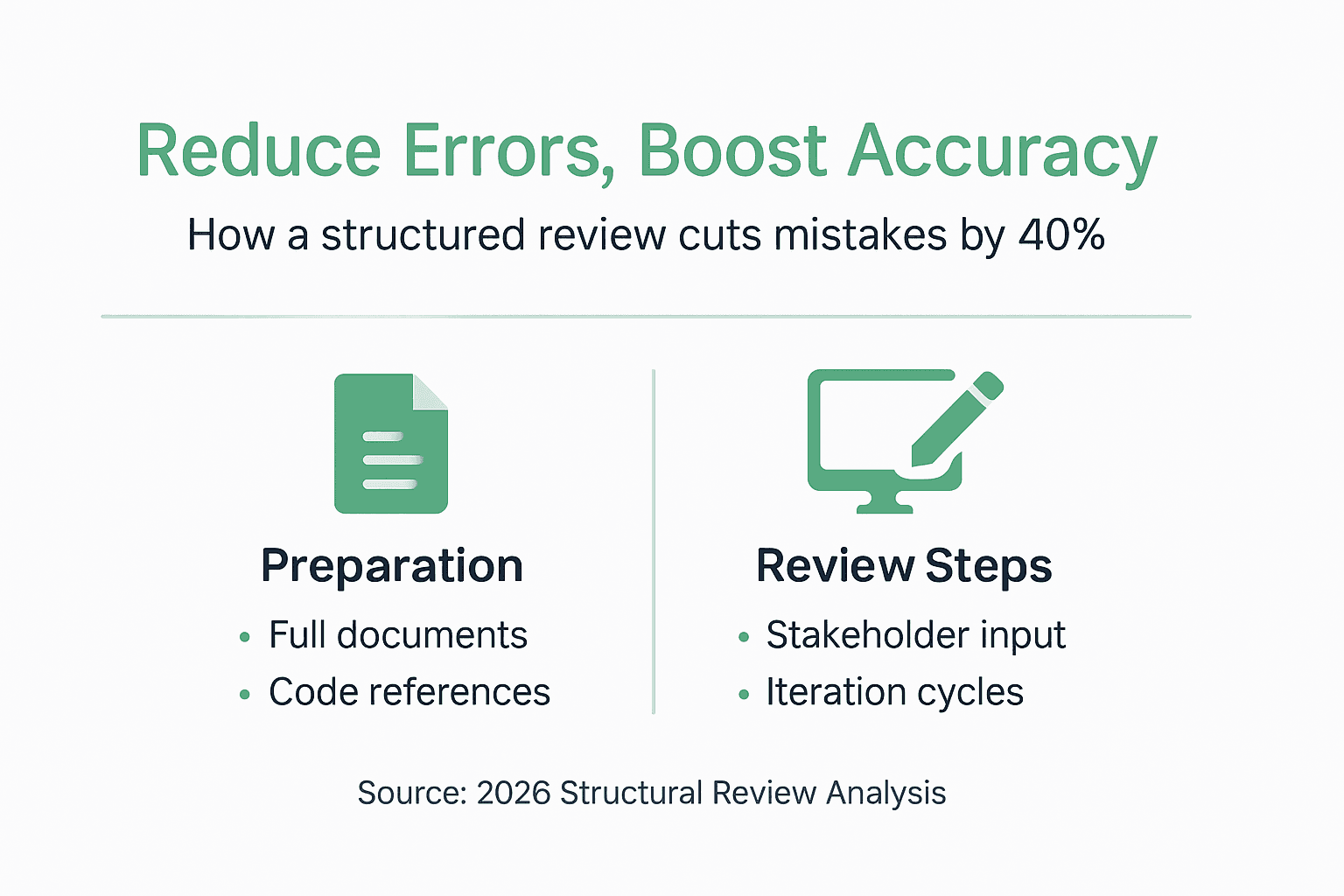
Rushed structural drawing reviews cost projects thousands in rework and delays. Up to 40% of structural drawing reviews fail due to overlooked dimension discrepancies and communication breakdowns. A systematic, phased approach transforms your review process into a reliable framework that catches errors early, ensures code compliance, and strengthens stakeholder coordination. This guide delivers a clear, actionable method to streamline reviews and protect project timelines.
Table of Contents
Key Takeaways
| Point | Details |
| Structured review process | Multi-step verification reduces errors and prevents costly project delays |
| Professional accountability | Verify licensed professional seals ensure legal compliance and design responsibility |
| Digital collaboration | Stakeholder feedback integrated through BIM platforms improves accuracy and communication |
| Code compliance verification | Confirm International Building Code standards are met to avoid safety and legal issues |
| Common pitfalls | Dimension errors and poor communication drive RFIs and rework costs |
Prerequisites: Prepare Before Starting the Review
Successful structural drawing reviews start with solid preparation. You cannot catch critical errors without the right foundation in place. Begin by verifying that all structural drawings include licensed professional seals and signatures. This confirms legal accountability and design responsibility from the start.
Gather your complete document set before diving into review work. You need structural drawings, architectural plans, specifications, and calculation packages in one accessible location. Missing documents create gaps that cascade into errors later.
Secure current building code references, particularly the International Building Code. Code requirements change frequently, and outdated versions compromise your compliance verification. Download digital copies for quick reference during review sessions.
Set up your digital review infrastructure early. Install PDF markup software like Bluebeam or comparable tools that support collaborative commenting. If your project uses Building Information Modeling, configure access to the shared BIM platform for real-time coordination.
Understand the project scope thoroughly before marking up a single sheet:
-
Review design criteria and load assumptions documented in calculations
-
Identify all stakeholders who will participate in the review cycle
-
Note any special conditions or site-specific requirements
-
Clarify decision authority for resolving conflicting comments
-
Document critical milestones and submission deadlines
Step 1: Initial Document Preparation and Tool Setup
Organizing your workflow sets the pace for everything that follows. Upload current structural drawings into your chosen review software to create a centralized access point for all team members. Version control matters here because working from outdated sheets wastes time and introduces conflicting markups.
Build a detailed review checklist tailored to your project scope and applicable code sections. Generic checklists miss project-specific requirements that cause problems during construction. Your checklist should map directly to drawing types, structural systems, and local jurisdiction requirements.
Assign clear roles to every review participant:
-
Designate who marks up drawings versus who approves changes
-
Establish comment ownership for each discipline involved
-
Define escalation paths for unresolved technical disputes
-
Set response time expectations for comment turnaround
-
Document communication protocols for urgent issues
Create realistic timelines with buffer for iteration cycles. Projects rarely complete review in one pass. Schedule milestones for initial comments, revised submissions, and final approval with enough spacing to accommodate quality work.
Pro Tip: Flag known problem areas or complex details upfront so reviewers focus attention where errors typically hide. This targeted approach catches issues faster than generic page-by-page reviews.
Integrate digital review and BIM collaboration tools early to streamline communication and reduce markup confusion. Teams using professional Revit BIM modelling services benefit from coordinated 3D models that surface clashes before they reach the field.
Step 2: Conduct a Detailed Review with Stakeholder Input
Circulate drawings to your full review team immediately after setup completes. Include project managers, structural engineers, architects, MEP consultants, and building inspectors in the first round. Each discipline brings unique perspectives that catch different error types.

Use project management software or BIM collaboration platforms to track every comment with clear ownership. Comments floating in email threads get lost and forgotten. Centralized tracking ensures nothing slips through review cycles.
Validate drawings against your code-based checklist systematically. Work section by section rather than jumping between sheets randomly. This structured review process prevents overlooked items and maintains consistent quality across all drawing packages.
Iterate drawings through multiple review cycles until all substantive comments resolve. Minor formatting issues can wait, but structural conflicts and code violations require immediate attention and re-circulation for verification.
Maintain transparent communication throughout every cycle. Ambiguous responses breed confusion and multiply RFIs during construction. Clear and accurate drawings reduce RFIs and change orders, decreasing delay-related costs by up to 30%.
| Review Approach | Comment Tracking | Error Detection Rate | Cycle Time | Team Coordination |
| Manual Paper-Based | Email/phone | 60-70% | 3-5 weeks | Fragmented |
| Digital Collaborative | Centralized platform | 85-95% | 2-3 weeks | Integrated |
Pro Tip: Schedule brief coordination calls between review cycles to resolve complex technical discussions that bog down in written comments. Ten minutes of conversation often clears issues that generate dozens of back-and-forth markups.
Teams leveraging professional Revit BIM modeling and as-built drawings in Revit or AutoCAD reduce iteration cycles by catching coordination conflicts in 3D before they appear on 2D sheets.
Step 3: Verify Code Compliance and Structural Integrity
Code compliance verification represents your final defense against costly field corrections and safety issues. Cross-check every structural element against International Building Code requirements applicable to your project location and occupancy type. Local amendments often add requirements beyond base IBC provisions.
Verify load path continuity from roof to foundation without gaps or assumptions. Trace lateral force-resisting systems completely, confirming connections transfer forces as calculations assume. Missing shear transfer details or inadequate anchor specifications cause failures that risk lives and destroy reputations.
Confirm reinforcement details match design calculations exactly:
-
Bar sizes, spacing, and development lengths
-
Splice locations and lap requirements
-
Cover dimensions for durability
-
Special detailing for seismic or high-wind regions
Ensure special inspections and structural observation roles are clearly defined in drawing notes and specifications. IBC structural observation guidelines require the Engineer of Record to verify conformance beyond basic inspections for critical structural elements.
Document every non-compliance issue with specific code section references and required corrections. Vague comments like “check code” waste time and frustrate design teams. Precise citations enable fast, accurate revisions.
Building departments reject incomplete submissions that lack proper documentation. Your review must catch these administrative requirements before formal submittal. Verify signature blocks, revision tracking, and sheet organization meet jurisdiction standards.
Pro Tip: Maintain a code compliance matrix that maps each structural system to relevant IBC sections. This visual tool ensures comprehensive coverage and simplifies documentation for building department reviews.
Projects utilizing structural detail drafting services benefit from accurate, code-compliant details that reduce review cycles and improve construction coordination.
Common Mistakes and Troubleshooting
Dimension and scale discrepancies rank among the most frequent errors that escape initial review. Mismatched dimensions between structural and architectural plans create costly field conflicts. Overlooking dimension discrepancies and poor stakeholder feedback integration cause up to 40% of review failures. Use standardized dimension verification checklists that force cross-referencing between related sheets.
Insufficient stakeholder comment integration generates waves of Requests for Information during construction. When review teams ignore or inadequately address discipline comments, coordination gaps appear in the field. Projects with poor communication experience up to 30% more RFIs and related delays. Implement mandatory response tracking that requires written closure for every substantive comment.
Incomplete code compliance checks create legal liability and require expensive rework:
-
Skipping seismic detailing requirements in high-risk zones
-
Overlooking fire rating requirements for structural elements
-
Missing accessibility provisions that affect structural design
-
Inadequate foundation design for soil conditions
Delays from poorly structured comment resolution cycles compound when teams lack clear processes. Comments recycling through multiple iterations without resolution signal broken workflows. Establish firm deadlines for comment responses and escalation procedures for disputes.
Pro Tip: Create a lessons learned database from past project issues. Tag common error types by drawing discipline and structural system. This searchable resource helps reviewers focus on historically problematic areas specific to your practice.
Address structural drawing review failure points proactively by enforcing multi-discipline reviews and collaborative tracking tools that surface issues before they cascade.
Expected Results and Outcomes
Review cycles typically range from 2 to 4 weeks depending on project complexity and team coordination quality. Simple projects with experienced teams trend toward shorter timelines, while complex structures requiring extensive coordination extend toward the upper range. Your preparation quality directly impacts cycle duration.
Measure success through concrete metrics that reflect review effectiveness. Target at least 30% reduction in RFIs compared to baseline project data. Track change orders attributed to drawing errors and coordination gaps. Monitor milestone adherence to quantify schedule reliability improvements.
Complete documentation provides audit trails that satisfy building departments and protect against disputes. Verify every sheet includes proper professional seals, revision tracking, and code compliance notes. This administrative completeness prevents rejection and resubmittal delays.
Improved communication transforms adversarial review processes into collaborative problem-solving. Design teams and contractors working from clear, coordinated drawings spend less time resolving conflicts and more time building quality projects. Structured reviews reduce finger-pointing and strengthen professional relationships.
| Metric | Manual Review | Structured Multi-Phase Review | Improvement |
| Drawing Error Rate | 15-20% | 5-8% | 60-70% reduction |
| RFI Volume | Baseline | 30% fewer | Significant decrease |
| Review Timeline | 4-6 weeks | 2-3 weeks | 40-50% faster |
| Change Order Costs | Baseline | 25-35% lower | Substantial savings |
| Stakeholder Satisfaction | Moderate | High | Measurable increase |
Construction errors and cost overruns drop dramatically when projects follow systematic review protocols. The upfront time investment in thorough review delivers exponential returns through smoother construction and fewer surprises. View typical timeline benchmarks as goals to achieve through disciplined process adherence.
Teams leveraging top Revit drafting services accelerate review cycles by starting with coordinated, accurate base models that reduce iteration requirements.
Enhance Your Structural Drawings Review with BIM.Supply Services
Thorough structural drawing reviews depend on accurate BIM models and precise drafting that minimize errors from the start. BIM.Supply delivers specialized services that transform rough sketches into detailed, coordinated digital models ready for construction.

Our professional Revit BIM modeling services convert your structural concepts into precise 3D models with accurate member sizing, connections, and coordination. Unit-rate pricing eliminates budget uncertainty while maintaining quality standards that reduce review cycles.
Complex projects require detailed structural elements captured to exact code specifications. Our structural detail drafting services provide the precision your reviews demand, ensuring every connection and reinforcement detail supports safe, compliant construction. Explore BIM.Supply solutions today to streamline project coordination and reduce costly review delays.
Frequently Asked Questions
How do I verify professional seals and signatures on structural drawings?
Confirm the seal includes the engineer’s name, license number, state of licensure, and expiration date clearly legible on every sheet. The signature must cross the seal and match the licensed professional’s name. Contact your state licensing board if you need to verify current license status.
What should I do when stakeholders provide conflicting comments during review?
Schedule a coordination meeting with affected parties to resolve technical disagreements before proceeding. Document the agreed resolution in meeting minutes and update drawings to reflect the consensus decision. Escalate unresolved conflicts to the project principal or owner for final direction.
How long should I expect structural drawing review cycles to take?
Typical projects complete review in 2 to 4 weeks depending on complexity and team coordination. Simple structures with experienced teams trend toward 2 weeks, while complex projects requiring extensive stakeholder input extend toward 4 weeks. Your preparation quality and communication processes significantly impact timeline.
Which tools provide the most efficient structural drawing review workflow?
Bluebeam Revu dominates PDF markup and coordination for 2D reviews. Autodesk BIM 360 or Revit collaboration tools excel for 3D model coordination. Procore or similar project management platforms effectively track comments and resolutions across disciplines. Choose tools your entire team can access and use consistently.
How can I ensure code compliance in complex structural designs?
Create a compliance matrix mapping each structural system to applicable IBC sections and local amendments. Engage third-party peer reviewers for complex or high-risk elements beyond your typical experience. Schedule early coordination with building department plan reviewers to clarify jurisdiction-specific interpretation questions before formal submittal.