

Complex construction projects face costly delays when design conflicts surface late in development. Multidisciplinary BIM can reduce late-stage design changes by up to 50% in complex projects by integrating architecture, structural engineering, and MEP disciplines from day one. This guide reveals how multidisciplinary BIM transforms collaboration, prevents errors, and accelerates timelines for architects and structural engineers working on US construction projects.
Table of Contents
-
How Multidisciplinary BIM Enhances Collaboration And Efficiency
-
Comparison Framework: Multidisciplinary BIM Vs. Single-Discipline BIM Approaches
Key Takeaways
| Point | Details |
| Integration drives efficiency | Multidisciplinary BIM combines architecture, structural, and MEP models to identify conflicts early and streamline coordination. |
| Clash detection reduces errors | Real-time conflict identification prevents structural and architectural elements from colliding, cutting rework by 15-25%. |
| Collaboration requires workflow standards | Success demands integrated protocols and leadership, not just shared software between disciplines. |
| Cloud platforms enable real-time access | Centralized data keeps all team members aligned on current design iterations throughout project lifecycles. |
| Early adoption maximizes ROI | Implementing multidisciplinary BIM during concept phases delivers the greatest cost and time savings. |
Introduction to Multidisciplinary BIM
Multidisciplinary BIM represents an integrated process combining models from multiple disciplines into a unified coordination framework. Unlike traditional siloed approaches where each team develops separate drawings, this methodology connects architecture, structural engineering, and MEP systems through shared digital environments. The core goal centers on preventing conflicts before construction begins while maintaining accurate data across all project phases.
Key disciplines participating in multidisciplinary BIM include:
-
Architecture teams creating spatial layouts, building envelopes, and interior design elements
-
Structural engineers modeling load-bearing systems, foundations, and framing components
-
MEP professionals designing mechanical ventilation, electrical distribution, and plumbing networks
-
General contractors coordinating construction sequencing and site logistics
This integration transforms how professionals collaborate. Instead of discovering beam and duct conflicts during construction, teams identify issues during design development. Autodesk BIM solutions provide platforms that merge these discipline-specific models into federated environments where coordination happens continuously rather than at isolated checkpoints.
The distinction between multidisciplinary BIM and simple file sharing matters enormously. True integration requires agreed-upon standards for model organization, naming conventions, and data exchange protocols. Without these frameworks, teams merely exchange files rather than collaborate within a unified system.
How Multidisciplinary BIM Enhances Collaboration and Efficiency
Real-time model sharing forms the backbone of effective multidisciplinary collaboration. When architects modify a wall location, structural engineers immediately see how that change affects their beam placements. This visibility eliminates the weeks-long lag times that plague traditional coordination methods where disciplines work in isolation until formal plan reviews.
Clash detection technology automatically identifies spatial conflicts between disciplines. A concrete column occupying the same space as a ventilation duct triggers instant alerts, allowing teams to resolve the issue during design rather than on-site. Multidisciplinary BIM reduces construction errors and rework by 15-25% through this proactive conflict resolution.
Centralized cloud-based platforms keep everyone working from current information. No more emailing outdated PDFs or discovering someone built from last month’s drawings. When a structural engineer updates foundation details, those changes immediately appear in the federated model accessible to all team members.
Quantified benefits extend beyond error reduction:
-
Design coordination meetings shrink from hours to minutes when issues are pre-identified
-
Request for information (RFI) volumes drop significantly due to clearer documentation
-
Construction schedules compress as fewer surprises emerge during building
-
Material waste decreases when accurate quantity takeoffs come from coordinated models
Pro Tip: Establish model update schedules where each discipline uploads current work at defined intervals, typically weekly during design development and daily during construction documentation. This rhythm prevents coordination chaos while maintaining workflow flexibility.
Services like Revit BIM modelling and architectural Revit modeling support this coordination by delivering discipline-specific models built to integration standards. When renovation projects require baseline documentation, as-built drawings services create accurate existing condition models that serve as foundations for multidisciplinary coordination.
The NIBS BIM benefits research demonstrates that coordination efficiency gains compound throughout project lifecycles, with early-phase integration delivering exponentially greater value than late-stage adoption.
Common Misconceptions About Multidisciplinary BIM
Many professionals mistakenly believe that simply using the same software constitutes multidisciplinary BIM. Reality proves more complex. Multidisciplinary BIM requires integrated workflows beyond simply sharing software, including common data environments, agreed-upon modeling standards, and coordinated exchange protocols.
Three prevalent misconceptions limit effective adoption:
-
Software equals integration: Teams assume purchasing identical platforms automatically enables collaboration, ignoring the need for standardized templates, family libraries, and naming conventions that allow models to merge cleanly.
-
BIM replaces communication: Some believe coordinated models eliminate the need for meetings and direct discussions, when reality shows technology enhances rather than replaces human coordination conversations.
-
Adoption happens organically: Organizations expect staff to naturally embrace new workflows without structured training, leadership support, or clear implementation roadmaps that address resistance and skill gaps.
The difference between file sharing and true integration becomes obvious during coordination. File sharing means emailing Revit files back and forth with informal change tracking. Integration means working within shared environments where model changes propagate automatically and clash reports generate on schedules without manual intervention.
Successful multidisciplinary BIM demands leadership commitment. Project managers must enforce modeling standards, allocate time for coordination activities, and address team members who resist collaborative workflows. Without executive support, integration initiatives collapse under the pressure of traditional deadline-driven practices.
Pro Tip: Develop a BIM execution plan at project kickoff that defines each discipline’s modeling responsibilities, file exchange schedules, and coordination meeting frequencies. This document becomes the contract governing how teams collaborate throughout the project.
The integrated BIM workflows documentation from industry leaders clarifies the difference between superficial software adoption and genuine process transformation.
Comparison Framework: Multidisciplinary BIM vs. Single-Discipline BIM Approaches
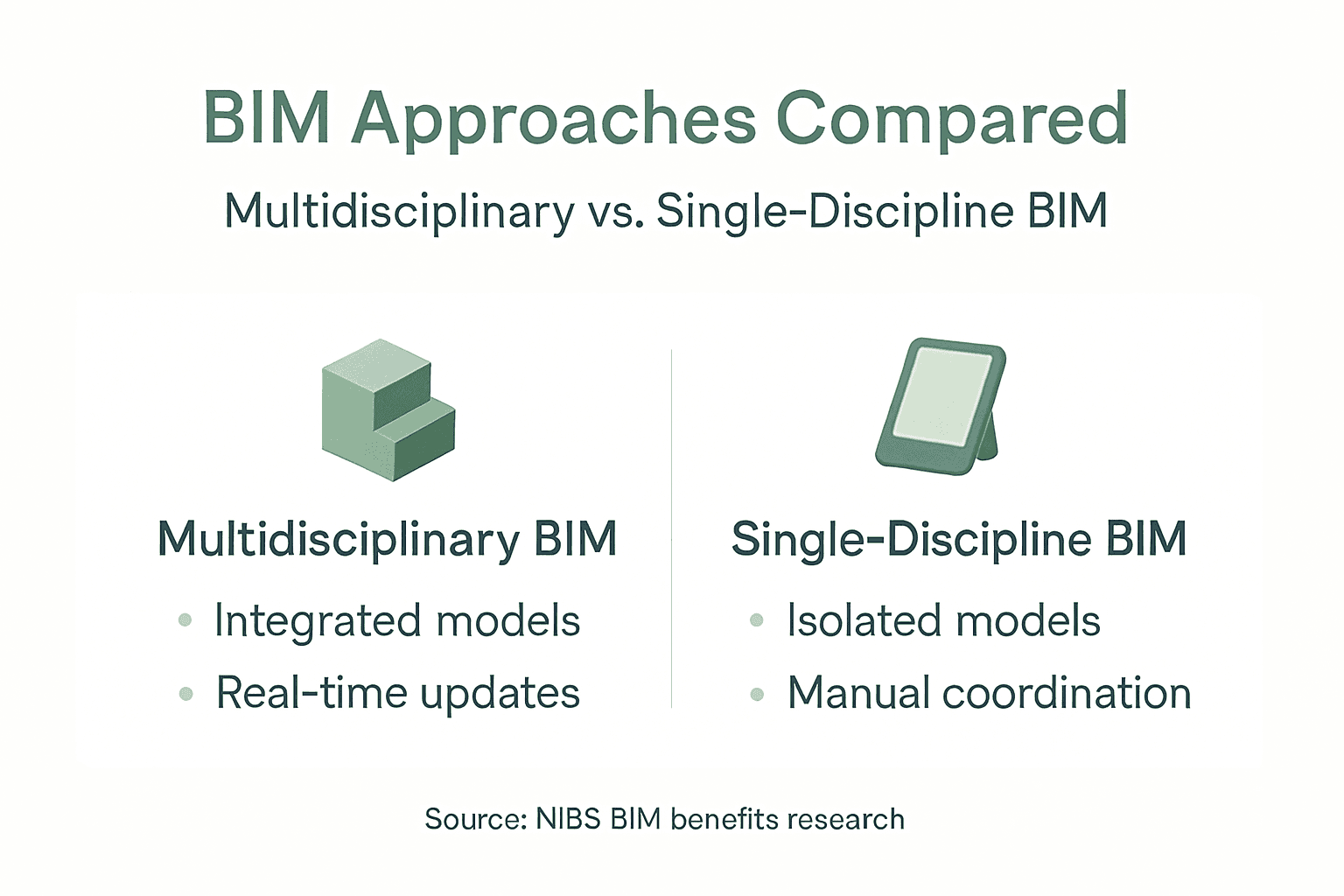
Understanding where multidisciplinary BIM adds value requires comparing it directly against isolated discipline modeling. The following framework highlights critical differences:
| Aspect | Multidisciplinary BIM | Single-Discipline BIM |
| Model structure | Federated models linking architecture, structural, and MEP components | Isolated discipline-specific models with no coordination links |
| Coordination mechanism | Automated clash detection across all disciplines with scheduled conflict reports | Manual plan overlay reviews at milestone submissions only |
| Change management | Automatic propagation of design changes to linked models with version tracking | Email notifications of changes requiring manual model updates |
| Data accessibility | Cloud-based central repository with real-time access for all authorized users | File server storage with potential version control conflicts |
| Conflict resolution timing | Design phase identification allowing low-cost corrections | Construction phase discovery requiring expensive field changes |
| Primary benefits | Reduced errors, compressed schedules, improved collaboration, lower construction costs | Discipline-specific accuracy, familiar workflows, minimal coordination overhead |
| Implementation complexity | High initial setup requiring standards development and team training | Low barrier to entry with discipline working in established methods |
| Best application | Complex projects with significant interdisciplinary coordination needs | Simple projects where disciplines have minimal interaction requirements |
The federated model concept deserves emphasis. Rather than forcing all disciplines into a single massive file, federated approaches maintain separate discipline models that link together for coordination. Architects work in their architectural model, structural engineers in their structural model, with both connecting in a coordination environment for clash detection.
This separation preserves discipline autonomy while enabling integration benefits. Structural engineers retain full control over their modeling standards and element properties while still participating in coordinated reviews. The alternative of everyone working in one unified model creates versioning nightmares and workflow bottlenecks.
Limitations exist even in well-executed multidisciplinary BIM. Small projects with minimal coordination needs may find the setup overhead exceeds benefits. Teams lacking technical expertise struggle with implementation. Organizations unwilling to invest in training see poor returns. Success requires matching the approach to project complexity and team capabilities.
Real-World Applications and Case Studies
A complex US hospital project in 2025 demonstrates multidisciplinary BIM’s practical impact. The 250,000 square foot facility involved intricate coordination between architectural spaces, structural systems, and extensive MEP networks serving operating rooms, imaging centers, and patient wards.
The project team implemented federated modeling with weekly coordination cycles. Multidisciplinary BIM reduced late-stage design changes by 50% compared to the client’s previous hospital built using traditional methods. Specific outcomes included:
-
43 major structural and MEP conflicts identified during design development rather than construction
-
12% reduction in total project duration through compressed coordination cycles
-
$2.3 million in avoided change orders from early conflict resolution
-
Zero major rework requests during the first six months of construction
Key lessons learned emphasized the importance of early adoption. The team initiated multidisciplinary coordination during schematic design rather than waiting for construction documents. This timing allowed fundamental layout adjustments before commitments hardened.
Challenges emerged around team training. Several subcontractors lacked BIM experience, requiring the general contractor to provide modeling support. Cloud platform access issues initially slowed coordination until IT departments resolved firewall configurations. Not every team member embraced the new workflows, necessitating project leadership intervention to maintain participation.

The BIM reduces design changes research documents similar results across multiple project types, showing consistent benefits when teams commit to integrated workflows. Renovation projects present additional complexity since existing conditions must be accurately captured before coordination can begin, but outcomes still justify the investment.
Challenges and Best Practices for Implementation
Common barriers prevent organizations from realizing multidisciplinary BIM’s full potential. The most significant obstacle involves treating BIM as merely software rather than a process transformation requiring workflow redesign. Teams purchase platforms, conduct minimal training, then wonder why collaboration fails to improve.
Resistance without proper training manifests when staff feel overwhelmed by new tools and unclear expectations. Experienced professionals comfortable with traditional methods see BIM as threatening their expertise rather than enhancing their capabilities. This psychological barrier requires addressing through structured change management, not just technical instruction.
Premature full model merging creates another common pitfall. Teams force all disciplines into single combined files, generating massive models that crash software and create versioning chaos. Successful approaches maintain discipline separation while linking models for coordination.
Best practices that overcome these challenges include:
-
Develop comprehensive BIM execution plans defining modeling standards, exchange protocols, and coordination schedules before project start
-
Use federated model approaches where disciplines maintain separate models linked for clash detection rather than merged into single files
-
Schedule regular coordination meetings with clash detection reports reviewed systematically by all disciplines
-
Leverage cloud platforms providing real-time model access, automated clash detection, and centralized communication
-
Assign BIM coordinators or managers with authority to enforce standards and resolve disputes
-
Invest in continuous training covering both software skills and collaborative workflows
Leadership commitment proves essential. Project executives must allocate budget for coordination activities, defend schedule time for BIM tasks, and support coordinators who enforce standards against resistant team members. Without top-down backing, multidisciplinary BIM initiatives collapse under deadline pressures.
Services like comprehensive BIM modelling and top Revit drafting services help organizations lacking internal capacity by providing expert modeling built to coordination standards. This support proves particularly valuable during adoption phases when teams build internal capabilities. BIM.Supply services offer flexible unit-rate pricing that scales with project needs rather than requiring fixed retainers.
Successful implementation follows phased approaches. Start with pilot projects of moderate complexity where teams can learn without catastrophic failure risks. Document lessons learned, refine standards, then expand to larger initiatives. Organizations attempting immediate transformation across all projects simultaneously typically struggle.
Conclusion: Bridging Understanding to Practical Application
Multidisciplinary BIM transforms construction project delivery by enabling architects, structural engineers, and MEP professionals to collaborate within integrated digital environments. The 50% reduction in late-stage design changes and 15-25% decrease in construction errors demonstrate quantifiable benefits that justify adoption investments.
Success requires understanding that multidisciplinary BIM represents process transformation, not merely software deployment. Integrated workflows, agreed-upon standards, and committed leadership matter more than platform selection. Cloud-based coordination, federated modeling approaches, and regular clash detection cycles form the technical foundation, while training and change management address human factors.
Architects and structural engineers can begin implementation by developing BIM execution plans for upcoming projects, establishing coordination meeting schedules, and investing in team training. Starting with moderate-complexity pilot projects allows capability building before tackling the most challenging work. Available professional services provide support during adoption phases when internal expertise develops.
The evidence shows multidisciplinary BIM delivers measurable improvements in collaboration efficiency, error reduction, and project outcomes. Moving from understanding to application requires commitment, but the competitive advantages and client value justify the effort.
Enhance Your Projects with Expert BIM Services
Transforming your practice with multidisciplinary BIM becomes simpler when you partner with experienced modeling professionals. BIM.Supply delivers comprehensive BIM modelling from initial concept through construction completion, ensuring your projects benefit from coordinated digital environments without building full in-house teams.
Our specialized architectural Revit modeling services and structural BIM modeling services create discipline-specific models built to coordination standards that integrate seamlessly in federated environments. Unit-rate pricing provides cost predictability while our experienced technicians handle modeling complexity.
Pro Tip: Engage BIM service providers during early project phases to establish modeling standards and coordination protocols before design development intensifies. This proactive approach prevents costly mid-project workflow adjustments.
Frequently Asked Questions
What disciplines are involved in multidisciplinary BIM?
Multidisciplinary BIM typically involves architecture, structural engineering, and MEP (mechanical, electrical, plumbing) disciplines working in coordinated digital models. Larger projects may include civil engineering, landscape architecture, and speciality consultants like lighting designers or acoustical engineers.
How does clash detection in multidisciplinary BIM reduce construction errors?
Clash detection software automatically identifies spatial conflicts between discipline models, such as structural beams intersecting HVAC ducts. Teams resolve these conflicts during design when changes cost little, preventing expensive field rework and schedule delays during construction.
What are the key challenges in adopting multidisciplinary BIM?
Main challenges include treating BIM as software rather than process transformation, insufficient training causing team resistance, lack of leadership support for coordination activities, and premature attempts to merge all disciplines into single model files. Successful adoption requires addressing both technical and human factors.
Can multidisciplinary BIM be used for small renovation projects?
Yes, though the setup overhead must justify project complexity. Small renovations with minimal interdisciplinary coordination may not benefit enough to warrant full multidisciplinary implementation. Projects involving significant MEP modifications or structural alterations typically justify the investment regardless of size.
How do cloud platforms support multidisciplinary BIM collaboration?
Cloud platforms provide centralized model repositories where all team members access current design iterations in real time. They automate clash detection on schedules, maintain version histories, enable mobile access for field personnel, and integrate communication tools that connect coordination activities with specific model elements.
What is the difference between federated and merged BIM models?
Federated models maintain separate discipline-specific files that link together for coordination while preserving independent control. Merged models combine all disciplines into single files, creating version control challenges and workflow bottlenecks. Most successful multidisciplinary projects use federated approaches.