

Many professionals dismiss structural detailing as mere drafting work, but this misconception can derail projects. Structural detailing bridges design intent and construction reality, translating engineering vision into precise, fabrication-ready documentation. Without it, even brilliant designs fail on site. This guide clarifies structural detailing’s purpose, processes, and impact on building projects.
Table of Contents
- Introduction To Structural Detailing
- The Role Of Structural Detailing In Construction Management
- Key Elements And Types Of Structural Detail Drawings
- Integration Of Structural Detailing With BIM And Digital Workflows
- Common Misconceptions About Structural Detailing
- Comparing Structural Detailing Across Materials
- Practical Application And Best Practices
- Conclusion And Next Steps
- Explore BIM.supply Structural Detailing Services
- Frequently Asked Questions
Key takeaways
| Point | Details |
|---|---|
| Translation role | Structural detailing converts engineering designs into precise construction and fabrication documentation |
| BIM integration | Modern 3D coordination and clash detection reduce errors and improve project timelines significantly |
| Material specificity | Steel, concrete, and timber require distinct detailing approaches due to unique connection and fabrication requirements |
| Cost impact | Proper detailing minimises expensive on-site rework, delays, and requests for information during construction |
| Early collaboration | Engaging detailers early in design phase prevents costly changes and enhances constructability outcomes |
Introduction to structural detailing
Structural detailing is the critical phase that transforms conceptual structural designs into precise, fabrication-ready construction documents. This process involves creating detailed drawings that specify every connection, member dimension, reinforcement layout, and assembly sequence needed to build structural elements safely and accurately. Effective structural detailing includes comprehensive documentation of load paths and connection sequencing to maintain design intent during fabrication.
These drawings serve as the primary communication tool between structural engineers, fabricators, and contractors. They ensure compliance with building codes, material standards, and safety regulations whilst addressing practical constructability concerns. Detailing documents must account for manufacturing tolerances, erection sequences, and site conditions that influence how structural components fit together.
The detailing phase bridges the gap between what engineers design and what construction teams can actually build. Without thorough detailing, even structurally sound designs can fail during construction due to unclear fabrication instructions, missing connection details, or coordination conflicts with other building systems. Professional structural engineering design and detailing ensures every element can be fabricated, transported, and assembled efficiently on site.
Pro tip: Engage your structural detailer during the preliminary design phase, not after engineering is complete. Early involvement identifies constructability issues before they become expensive change orders.
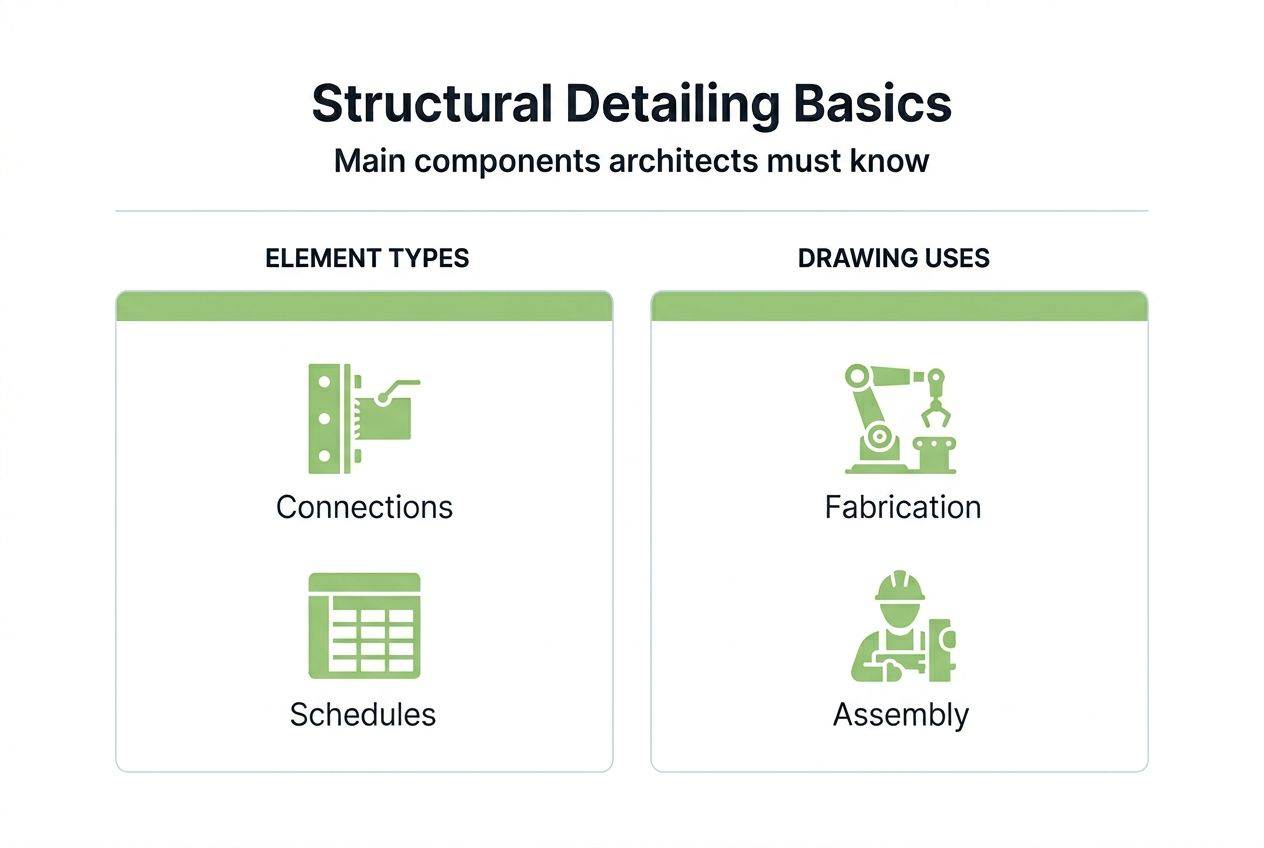
Structural detailing encompasses several deliverables including connection details showing how members join, schedules listing all structural components with dimensions and specifications, and fabrication drawings that guide manufacturing processes. Each drawing type serves distinct stakeholders at different project phases.
The role of structural detailing in construction management
High-quality structural detailing directly improves on-site constructability by providing clear, unambiguous instructions that reduce interpretation errors. Construction teams receive precise information about member sizes, connection hardware, welding specifications, and installation sequences, eliminating guesswork that causes delays and costly mistakes.

Modern detailing workflows integrate Building Information Modelling to detect clashes before construction begins. When structural elements conflict with mechanical ductwork, electrical conduits, or architectural features, BIM coordination identifies these issues during detailing rather than during expensive on-site corrections. This proactive approach prevents the cascading delays that occur when trades discover conflicts mid-construction.
Comprehensive detailing significantly reduces requests for information during construction. When contractors encounter unclear or missing information, RFIs halt work whilst waiting for engineering clarification. Projects with thorough detailing documentation experience fewer RFIs because fabricators and installers have complete information from the start. Studies show that reviewing structural drawings systematically can cut errors by 40 per cent.
Detailing facilitates smooth coordination among multiple stakeholders including structural engineers who verify design intent, steel fabricators who manufacture components, concrete contractors who place reinforcement, and general contractors who manage installation sequences. Clear documentation ensures everyone works from consistent, coordinated information.
The economic impact of quality detailing extends beyond error prevention. Accurate fabrication drawings reduce material waste by ensuring components are manufactured to precise specifications the first time. Clear erection sequences minimise site labour hours by guiding efficient assembly. These efficiencies compound across large projects, generating substantial cost savings.
Key elements and types of structural detail drawings
Connection details form the cornerstone of structural detailing documentation. These drawings specify how beams connect to columns, how trusses attach to supporting members, and how foundation elements transfer loads. Each connection detail must show bolt patterns, weld specifications, plate thicknesses, and assembly sequences.
Member schedules provide comprehensive lists of all structural components with their dimensions, materials, quantities, and identifying marks. These schedules enable fabricators to organise production efficiently and help site teams track deliveries and installation progress. Schedules typically include beams, columns, braces, and connection hardware.
Roof truss details illustrate complex assemblies including chord members, web configurations, bearing conditions, and connection hardware. These drawings must account for load transfer paths, deflection considerations, and practical erection sequences. Reinforced concrete joint details show reinforcement bar placement, lap lengths, concrete covers, and construction joint locations.
Shop drawings represent fabrication-ready instructions that manufacturers use to produce structural components. These drawings include all dimensions, tolerances, material specifications, and quality control requirements needed for fabrication. Shop drawings undergo rigorous review cycles to verify they match design intent before manufacturing begins.
Coordination drawings overlay multiple building systems to identify spatial conflicts. These drawings help detect where structural members interfere with mechanical equipment, electrical pathways, or architectural elements. Early clash detection through coordination drawings prevents expensive field modifications.
Professional architectural and structural detail drafting services produce these varied drawing types with precision and consistency. Each drawing type supports different stakeholders:
- Engineers verify design intent and code compliance
- Fabricators manufacture components to exact specifications
- Contractors plan installation sequences and resource allocation
- Inspectors confirm construction matches approved documents
Integration of structural detailing with BIM and digital workflows
Building Information Modelling revolutionises structural detailing by enabling precise 3D coordination and automated clash detection. Modern structural detailing increasingly relies on BIM technologies to integrate coordination, clash detection, and fabrication-ready modelling that enhances collaboration among project teams.
BIM models contain rich data beyond geometry including material properties, load capacities, connection types, and fabrication specifications. This embedded intelligence allows automated checking of design compliance, material quantity take-offs, and construction sequencing validation. Detailers working in BIM environments produce more accurate documentation because the model enforces consistency across all drawing views.
Fabrication-ready BIM models streamline the transition from design to manufacturing. Steel fabricators can import BIM geometry directly into computer numerical control machines, eliminating manual data transfer that introduces errors. Concrete contractors extract rebar schedules and placing drawings directly from coordinated models. This digital continuity reduces errors and compresses project timelines.
Collaboration improves dramatically when all disciplines work within federated BIM models. Architects, engineers, contractors, and fabricators access current, coordinated information simultaneously rather than passing outdated drawings back and forth. Cloud-based BIM platforms enable real-time coordination across geographically distributed teams.
Implementing efficient BIM integration in structural drawings workflow transforms project delivery by connecting design, detailing, fabrication, and construction through a unified digital thread.
Adoption rates demonstrate BIM’s value. Research shows that BIM modelling trends in 2026 indicate 68 per cent adoption boosts efficiency across construction projects. Firms investing in BIM technologies report fewer design changes, reduced rework, and faster project delivery compared to traditional 2D workflows.
BIM’s parametric capabilities allow rapid design iteration during detailing. When engineering changes occur, updates propagate automatically through linked drawings and schedules. This responsiveness prevents the documentation lag that plagues traditional detailing workflows where each change requires manual updates across multiple drawings.
Common misconceptions about structural detailing
Many professionals mistakenly view structural detailing as clerical drafting work requiring minimal technical expertise. This misconception dangerously underestimates the engineering judgement, material knowledge, and constructability insight that quality detailing demands. Structural detailers must understand load paths, connection behaviour, material properties, and fabrication constraints to produce effective documentation.
Treating detailing as optional or relegating it to the cheapest provider risks project safety and budget. Inadequate detailing creates ambiguous construction documents that lead to field interpretation errors, unsafe construction practices, and structures that don’t perform as designed. The cost of correcting these errors during construction far exceeds investment in proper detailing upfront.
Some teams assume detailing can begin after engineering is completely finished. This sequential approach misses opportunities for detailers to identify constructability issues whilst design changes remain inexpensive. Early detailer involvement surfaces fabrication constraints, erection challenges, and coordination conflicts when addressing them costs least.
Pro tip: Budget adequate time for detailing review cycles. Rushing this phase to meet construction deadlines inevitably causes expensive errors that delay the project far longer than proper detailing would have taken.
Underestimating detailing complexity leads to insufficient staffing and unrealistic schedules. Complex projects require experienced detailers who understand the specific demands of the structural system, materials, and construction methods involved. Attempting to fast-track detailing with inexperienced staff or inadequate resources guarantees problems.
The misconception that detailing merely reproduces engineering drawings ignores the substantial interpretation, coordination, and constructability analysis that detailing requires. Engineers produce design drawings showing overall structural concepts. Detailers transform these concepts into hundreds of detailed drawings specifying every bolt, weld, reinforcement bar, and assembly step needed for construction.
Comparing structural detailing across materials
Structural detailing must cover material-specific requirements with distinct practices for steel, reinforced concrete, and timber structures addressing unique connection, fabrication, and performance characteristics.
| Material | Primary Detailing Focus | Critical Connection Types | Fabrication Considerations |
|---|---|---|---|
| Steel | Bolt patterns, weld specifications, member profiles, erection sequences | Moment connections, shear connections, base plates, splice joints | Shop fabrication precision, transportation limits, field assembly sequences |
| Reinforced concrete | Reinforcement layout, concrete cover, bar spacing, lap lengths | Beam-column joints, foundation connections, construction joints, continuity reinforcement | Formwork coordination, rebar congestion, concrete placement access, curing requirements |
| Timber | Joinery details, load paths, connector hardware, moisture protection | Moment-resisting joints, shear connections, foundation anchorage, lateral bracing | Grain orientation, member sizes, hardware capacity, shrinkage accommodation |
Steel detailing emphasises precision in connection geometry and member profiles. Bolt hole locations must align within millimetre tolerances across components fabricated in different shops. Weld specifications must account for base metal properties, joint configurations, and inspection requirements. Steel detailers coordinate member profiles with connection hardware, ensuring adequate clearances for bolting and welding access.
Concrete detailing focuses on reinforcement placement and concrete cover requirements. Bar schedules must specify sizes, lengths, bend configurations, and placement locations for thousands of reinforcement elements. Detailers ensure adequate concrete cover for corrosion protection whilst maintaining sufficient bar spacing for concrete placement. Congested reinforcement zones require careful detailing to ensure constructability.
Timber detailing addresses joinery methods, moisture control, and load path continuity through connections. Detailers specify appropriate fastener types and quantities based on member grain orientation and load directions. Timber connections require attention to shrinkage effects, differential movement between members, and protection from moisture exposure. Load paths through timber connections must account for material anisotropy and varying capacities in different grain directions.
Each material’s fabrication process influences detailing requirements. Steel detailing standards and resources guide shop fabrication workflows where precision machining enables tight tolerances. Concrete detailing accommodates site-placed reinforcement with more flexible tolerances. Timber detailing balances manufactured precision for engineered lumber with natural material variability.
Practical application and best practices
Implementing effective structural detailing requires deliberate process management and stakeholder coordination. Follow these proven practices to optimise detailing outcomes:
-
Engage structural detailers during preliminary design when major system decisions occur. Their constructability input prevents unworkable details before they’re locked into construction documents. Early involvement costs nothing but saves substantially by avoiding later redesigns.
-
Establish clear communication protocols between engineers, detailers, fabricators, and contractors. Regular coordination meetings surface issues whilst solutions remain straightforward. Define review responsibilities, submission schedules, and approval processes at project start.
-
Use BIM coordination tools to detect clashes before detailing progresses too far. Weekly or biweekly coordination sessions catch conflicts early when resolution requires minimal rework. Optimising drafting efficiency in BIM projects requires systematic coordination workflows.
-
Implement rigorous internal review before submitting detailing packages. Check dimensions, connection capacities, material specifications, and drawing consistency. Internal checking catches errors at minimal cost compared to field corrections.
-
Build adequate schedule buffer for detailing review cycles. Engineering review, contractor review, and fabricator review each require time. Rushing reviews to meet construction deadlines causes errors that delay projects far longer than proper review requires.
Pro tip: Create a master tracking system that links each detail drawing to its design basis, review status, and fabrication schedule. This coordination prevents details from falling through communication gaps between stakeholders.
Iterative feedback between detailers and fabricators improves constructability. Fabricators understand manufacturing constraints, transportation limits, and erection sequences that influence detail design. Incorporating their input during detailing prevents shop drawing revisions that delay fabrication.
Systematic structural drawing review processes that cut errors by 40 per cent follow consistent checking procedures. Develop review checklists covering connection capacities, code compliance, material specifications, and coordination with adjacent systems. Train reviewers to look beyond obvious errors toward constructability and long-term performance issues.
Document detailing decisions and design assumptions explicitly. When future questions arise during construction or building modifications, clear documentation prevents misinterpretation. Include design calculations, material test reports, and coordination meeting minutes in project records.
Conclusion and next steps
Structural detailing forms the essential link between engineering design and successful construction. This critical phase translates conceptual designs into precise, coordinated documentation that enables safe, efficient building. Quality detailing prevents costly errors, reduces construction delays, and ensures structures perform as engineers intended.
Precision in detailing directly impacts project economics. Thorough documentation minimises field rework, reduces material waste, cuts RFI volumes, and accelerates construction schedules. These benefits compound across project duration, generating substantial cost savings that far exceed detailing investment.
Collaborative workflows and BIM integration represent the future of structural detailing. Projects that embrace early stakeholder coordination, 3D clash detection, and digital fabrication workflows consistently outperform traditional approaches. As construction technology advances, detailing quality increasingly determines project success.
Moving forward, prioritise detailing as a strategic project phase deserving adequate time, budget, and expertise. Engage experienced detailers early, invest in BIM coordination tools, and establish rigorous review processes. These practices transform detailing from a potential liability into a competitive advantage that delivers better buildings faster and more economically.
Explore BIM.supply structural detailing services
Transforming structural designs into construction-ready documentation requires specialised expertise and proven workflows. BIM.supply delivers comprehensive structural BIM modelling from concept to completion that coordinates seamlessly with architectural and MEP systems.

Our architectural and structural detail drafting services produce precise fabrication drawings that minimise errors and accelerate construction. Whether you need connection details, reinforcement schedules, or shop drawing coordination, our experienced team delivers documentation that meets fabricator requirements and code standards.
For projects requiring comprehensive support, all-inclusive BIM modelling services streamline workflows from design through construction. Unit-rate pricing provides cost predictability whilst our experienced team handles coordination, clash detection, and drawing production. Reduce project risks whilst improving constructability through professional structural detailing that bridges design intent and construction reality.
Frequently asked questions
What qualifications should a structural detailer have?
Structural detailers typically hold engineering technology diplomas or degrees in civil or structural engineering, combined with specialised training in detailing software and fabrication processes. Professional detailers demonstrate expertise in material behaviour, connection design, building codes, and construction methods specific to their material focus whether steel, concrete, or timber. Many jurisdictions recognise formal certification programmes that validate detailing competency through examination and experience requirements. Effective detailers combine technical knowledge with practical understanding of fabrication constraints, erection sequences, and constructability challenges that influence detail design.
How does BIM improve structural detailing accuracy?
BIM enables precise 3D coordination that automatically detects spatial conflicts between structural elements and other building systems before construction begins. The intelligent model enforces geometric consistency across all drawing views, preventing the dimension conflicts common in traditional 2D workflows. Parametric relationships ensure that design changes propagate automatically through linked drawings and schedules, maintaining documentation accuracy throughout project evolution. Collision detection algorithms identify interferences that manual review might miss, particularly in congested areas with complex geometry.
What are common mistakes to avoid in structural detailing?
Treating detailing as optional or purely clerical work represents the most damaging mistake, leading to inadequate documentation that causes construction errors. Failing to document complete load paths and connection force transfers creates ambiguous drawings that field personnel must interpret, risking unsafe construction practices. Neglecting BIM coordination allows spatial conflicts to reach construction where resolution costs escalate dramatically. Starting detailing too late in project schedules forces rushed work that introduces errors and misses constructability issues best addressed during design.
How early should structural detailing begin in a project?
Structural detailing should commence as soon as engineering design reaches sufficient development to define primary structural systems, member sizes, and connection concepts. This early engagement typically occurs during design development phase, well before construction documents are complete. Early detailer involvement enables constructability input whilst design changes remain inexpensive and coordination with other disciplines proceeds smoothly. Waiting until engineering is finalised misses opportunities to optimise details for fabrication efficiency and identify conflicts before they require expensive redesign.
What is the difference between engineering drawings and shop drawings?
Engineering drawings communicate overall structural design intent, showing member locations, sizes, load requirements, and general connection types without fabrication-level detail. These design documents guide detailers and contractors but lack the precision needed for component manufacturing. Shop drawings provide fabrication-ready instructions with exact dimensions, tolerances, material specifications, bolt patterns, weld details, and assembly sequences. Fabricators produce shop drawings based on engineering drawings, adding the manufacturing and erection detail required for actual construction. Shop drawings undergo rigorous engineering review to verify they maintain design intent before fabrication proceeds.