

BIM Level 2 isn’t just about creating 3D models—that’s the most common misconception among UK architects and structural engineers. True BIM Level 2 focuses on structured data management and collaborative workflows that meet government compliance standards for public sector projects. Since the 2016 mandate requiring BIM Level 2 on all centrally funded UK projects, understanding its practical requirements and underlying standards has become essential for professional practice. This guide clarifies what BIM Level 2 actually means, the current UK standards framework, and how you can implement compliant workflows on your projects.
Table of Contents
- Introduction To BIM Level 2 In The UK
- Key Standards And Frameworks Behind BIM Level 2
- Core Components Of BIM Level 2 Implementation
- Common Misconceptions About BIM Level 2
- Benefits And Impact Of BIM Level 2 Adoption
- Evolution To UK BIM Framework And Information Management Initiative (IMI)
- Practical Steps For UK Architects And Engineers To Achieve BIM Level 2 Compliance
- Discover Expert BIM Modelling Solutions At BIM.Supply
- Frequently Asked Questions About BIM Level 2 In 2026
Key takeaways
| Point | Details |
|---|---|
| BIM Level 2 is a collaborative digital process | It requires structured data management across disciplines using defined standards, not just 3D modelling capabilities. |
| UK BIM Framework replaced BIM Level 2 policy | The framework builds on ISO 19650 standards and emphasises whole-life asset information management from 2023 onwards. |
| Core compliance components are EIR, BEP, and CDE | Every compliant project needs Employers Information Requirements, a BIM Execution Plan, and a Common Data Environment. |
| Common misconceptions hinder effective adoption | Many still confuse BIM Level 2 with only 3D work or believe CDEs are optional for compliance. |
| Proven benefits include time and cost savings | Projects demonstrate reduced coordination errors, faster planning cycles, and material waste reduction through better collaboration. |
Introduction to BIM Level 2 in the UK
BIM Level 2 represents a structured approach to digital construction collaboration where multiple disciplines create and share federated information models. It’s not about one giant 3D model—it’s about separate discipline models that can reference, exchange, and federate data through agreed standards and processes. The UK government mandated BIM Level 2 compliance on all centrally funded public projects since 2016 to improve collaboration and reduce waste.
For architects and structural engineers working in the UK, this mandate means you must understand and demonstrate compliance capabilities when bidding for public sector work. Even on private projects, clients increasingly expect BIM Level 2 workflows because of the efficiency gains and risk reduction they deliver. The mandate applies to projects across healthcare, education, infrastructure, and government buildings.
BIM Level 2 enhances collaboration by establishing clear protocols for how teams share information, define responsibilities, and maintain data quality throughout project lifecycles. The framework reduces inefficiencies by catching clashes earlier, improving coordination between structural and architectural elements, and creating a single source of truth for project data.
Key characteristics of BIM Level 2 include:
- Discipline-specific models that federate together rather than one master model
- Mandatory use of standardised file formats like IFC for data exchange
- Structured naming conventions and classification systems such as Uniclass 2015
- Defined workflows for information approval and version control
- Clear assignment of model ownership and responsibility matrices
Understanding these fundamentals positions you to implement compliant processes and meet client expectations on contemporary UK construction projects.
Key standards and frameworks behind BIM Level 2
The original foundation for BIM Level 2 was PAS 1192-2:2013, which specified information management requirements for the capital delivery phase of construction projects. This British standard defined how organisations should structure their BIM workflows, documentation, and data exchanges. PAS 1192-2 introduced concepts like the Common Data Environment and established the framework for EIR and BEP documentation.
ISO 19650 series offers an international standard for managing BIM information throughout the project lifecycle, superseding PAS 1192 standards in the UK. ISO 19650 Part 1 covers concepts and principles for information management, while Part 2 addresses the delivery phase of assets. These international standards brought UK practice in line with global approaches whilst maintaining the collaborative principles established by PAS 1192.
The UK BIM Framework, built on ISO 19650 standards, replaced BIM Level 2 as the government’s main BIM policy, focusing on whole-life information management. This evolution reflects a maturation from project-phase thinking to asset lifecycle thinking. The framework guides organisations through implementing information management practices that extend beyond construction into operational phases.
| Aspect | PAS 1192 Series | ISO 19650 |
|---|---|---|
| Geographic scope | UK specific standard | International standard adopted by UK |
| Lifecycle coverage | Primarily capital delivery phase | Full asset lifecycle from concept to disposal |
| Status | Superseded but still referenced | Current active standard |
| Information containers | Focused on traditional project documentation | Emphasises structured data and digital twins |
| Adoption requirement | Required for BIM Level 2 mandate pre-2023 | Foundation for UK BIM Framework from 2023 |
Key differences between the frameworks include ISO 19650’s broader international applicability and its emphasis on information management rather than just BIM processes. ISO 19650 introduces more flexible appointment structures and clearer distinction between appointing and appointed parties. The standard also better accommodates diverse project delivery models and procurement routes.
The UK BIM Framework integrates guidance on standards, competency frameworks, and practical resources to support implementation across the construction industry. It provides pathways for organisations at different maturity levels to develop their capabilities systematically.
Pro Tip: Bookmark the UK BIM Framework website and subscribe to updates—standards evolve, and aligning your project templates and workflows with current guidance keeps you competitive and compliant.
Core components of BIM Level 2 implementation
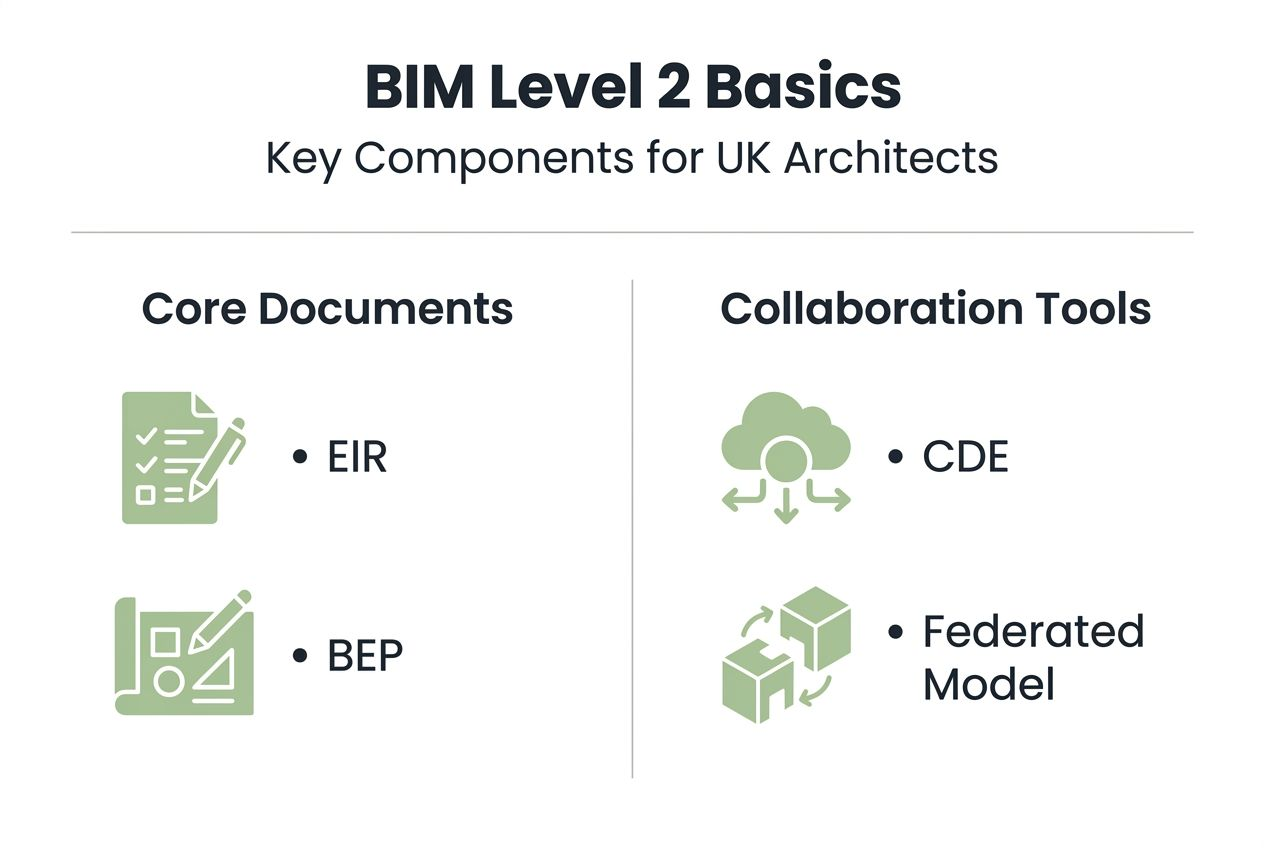
Employers Information Requirements (EIR) define what information the client needs, when they need it, and in what format throughout the project. BIM Level 2 compliance requires production of an Employers Information Requirements (EIR) document and a BIM Execution Plan (BEP) specifying roles, standards, and workflows aligned to the project programme. The EIR sets technical, management, and commercial requirements that guide how the supply chain delivers information.

The BIM Execution Plan (BEP) responds to the EIR by detailing how the delivery team will meet those requirements. A pre-contract BEP demonstrates capability during tender, whilst the post-contract BEP becomes the working document defining roles, responsibilities, software platforms, naming conventions, and information exchange protocols. The BEP assigns clear ownership for model elements and establishes review and approval workflows.
BIM Level 2 requires development of information models that can reference, federate, or exchange data with other models using a Common Data Environment to facilitate collaboration. The CDE provides a single source of truth where all project information resides, with controlled workflows moving data through work-in-progress, shared, published, and archived states. Without a functioning CDE, teams cannot maintain the version control and audit trails required for compliance.
Supplier capability assessments ensure your supply chain can deliver to BIM Level 2 standards. These assessments evaluate software competency, understanding of standards, previous BIM project experience, and organisational information management maturity. Capability gaps identified early allow time for training or alternative supplier selection.
Integrating these components creates a cohesive system where:
- The EIR communicates client needs clearly upfront
- The BEP documents how those needs will be met through defined processes
- The CDE provides the infrastructure for controlled information exchange
- Supplier assessments verify the team can execute the plan
- Regular reviews ensure ongoing alignment throughout project delivery
This integration facilitates seamless coordination between architectural design, structural engineering, MEP services, and other disciplines, reducing clashes and rework.
Pro Tip: Treat your BEP as a living document—schedule formal reviews at each RIBA stage boundary to update responsibilities, deliverables, and protocols as the project evolves and the team composition changes.
Common misconceptions about bim level 2
Many professionals mistakenly believe BIM Level 2 simply means producing 3D models instead of 2D drawings. Common misconceptions include confusing BIM Level 2 as merely 3D modelling when it actually emphasises structured data management and collaborative workflows. The 3D geometry is just one component—the real value comes from the data attached to model objects, the coordination between disciplines, and the information management processes.
Another frequent confusion conflates BIM Level 2 with the UK BIM Framework as if they’re interchangeable terms. The UK BIM Framework represents the evolution beyond BIM Level 2, incorporating ISO 19650 standards and extending focus to whole asset lifecycle management. BIM Level 2 was a specific mandate and maturity level, whilst the framework provides ongoing guidance and resources.
Some practitioners incorrectly assume Common Data Environments are optional or just a nice-to-have technology platform. CDEs are mandatory for BIM Level 2 compliance because they provide the controlled environment necessary for information exchange, version management, and audit trails. Without a CDE, you cannot demonstrate the collaborative workflows and data governance that BIM Level 2 requires.
Other misconceptions that hinder implementation include:
- Believing BIM Level 2 only applies to large, complex projects rather than all public sector work
- Thinking compliance is achieved simply by using Revit or other BIM authoring software
- Assuming BIM Level 2 is a one-time achievement rather than an ongoing process throughout project delivery
- Confusing information modelling with visualisation or rendering capabilities
- Believing federated models eliminate the need for discipline-specific expertise and coordination
These misunderstandings lead to inadequate preparation, non-compliant deliverables, and missed opportunities to realise BIM’s efficiency benefits. Clear distinction between BIM maturity levels (0, 1, 2, 3) and implementation frameworks helps teams understand what’s actually required versus what’s aspirational.
Benefits and impact of BIM Level 2 adoption
BIM Level 2 reduces project planning and coordination time by enabling early clash detection between structural, architectural, and services elements. Coordination issues identified digitally before construction avoid costly site delays and rework. Teams report 20 to 30 percent reductions in coordination meeting time because federated models make conflicts visible immediately.
Material cost savings emerge through better quantity take-offs, waste reduction, and optimised structural solutions. Accurate model-based quantities reduce over-ordering and material waste on site. Structural engineers can analyse multiple design options quickly, identifying efficient solutions that balance performance and cost. Projects with robust BIM processes demonstrate 5 to 15 percent material cost reductions compared to traditional workflows.
Improved collaboration stems from shared visual references and common data environments where all disciplines access current information. Architects and structural engineers work from coordinated models rather than outdated drawings, reducing errors from miscommunication. Clear protocols in BEP documents define who updates what and when, eliminating confusion about responsibilities.
Project timelines benefit from parallel working enabled by federated models and reduced rework from better coordination. Design freezes happen earlier with greater confidence because teams have validated coordination digitally. Construction programmes compress when site teams receive accurate, coordinated information packages.
Recent data shows BIM adoption continues growing—68 percent of UK construction professionals now use BIM, demonstrating mainstream acceptance and proven value. Projects implementing multidisciplinary BIM coordination cut design changes by 50 percent compared to traditional approaches.
Key benefits include:
- Enhanced quality through coordinated, clash-free designs
- Better risk management via early identification of constructability issues
- Improved health and safety planning using 4D simulations
- Stronger client relationships through transparent progress tracking
- Competitive advantage when bidding for public sector projects
These tangible outcomes explain why clients increasingly specify BIM requirements even on private projects, recognising the risk reduction and value improvement it delivers.
Evolution to UK BIM Framework and Information Management Initiative (IMI)
The UK BIM Framework replaced BIM Level 2 as the government’s primary policy direction in 2023, marking a significant shift from project-focused mandates to asset lifecycle thinking. The UK BIM Framework, built on ISO 19650 standards, replaced BIM Level 2 as the government’s main BIM policy, focusing on whole-life information management. This evolution recognises that construction projects are temporary activities within longer asset lifecycles spanning decades.
The Information Management Initiative (IMI) supports the UK BIM Framework by providing practical guidance, case studies, and resources for implementing ISO 19650 principles. The shift from BIM Level 2 to the Information Management Initiative (IMI) reflects a shift from focusing on 3D modelling to managing structured information over the asset lifecycle, supported by ISO 19650. The IMI emphasises information as a strategic asset requiring governance, quality control, and purposeful management.
This transition means professionals must think beyond project delivery to consider how information created during design and construction supports facility management, maintenance, refurbishment, and eventual decommissioning. Structured data becomes as important as geometric models because operators need searchable, updateable information about building components and systems.
| Aspect | BIM Level 2 (pre-2023) | UK BIM Framework (2023 onwards) |
|---|---|---|
| Primary focus | Project delivery phase collaboration | Whole asset lifecycle information management |
| Underlying standards | PAS 1192 series | ISO 19650 series |
| Policy status | Government mandate for public projects | Government guidance and best practice framework |
| Scope | Primarily construction and handover | From strategic planning through disposal |
| Information emphasis | Federated models and COBie data | Structured data for operational decision making |
The UK BIM Framework provides more flexibility in how organisations achieve information management maturity whilst maintaining rigorous standards. It supports diverse project types, procurement routes, and organisational structures better than the original BIM Level 2 mandate.
“The move from BIM Level 2 to the UK BIM Framework represents a paradigm shift—we’re no longer just coordinating construction data but creating valuable information assets that serve building owners and operators for decades.”
This evolution demands new competencies for architects and structural engineers, including understanding asset information requirements, creating information models suited for operational use, and collaborating with facility management teams. The framework challenges designers to consider the downstream value of every data point they create.
Practical steps for UK architects and engineers to achieve BIM Level 2 compliance
Step 1: Develop clear Employers Information Requirements (EIR) defining project needs, acceptable software platforms, file formats, data exchange protocols, and deliverable schedules. Review the UK BIM Framework templates and adapt them to your project’s specific context and client requirements. Engage clients early to understand their operational information needs beyond traditional construction outputs.
Step 2: Prepare detailed BIM Execution Plan (BEP) assigning roles, standards, timelines, and coordination responsibilities across all disciplines. Document your software environment, naming conventions based on BS 1192, classification system (typically Uniclass 2015), coordinate systems, and level of information need for each project stage. The BEP should respond point-by-point to every EIR requirement.
Step 3: Set up and maintain a Common Data Environment (CDE) for secure data sharing, version control, and audit trails. Select a platform that supports the workflow states (work in progress, shared, published documentation, archive) required by ISO 19650. Establish access permissions, naming protocols, and automated notifications for review cycles. Train all team members on CDE protocols before project commencement.
Step 4: Conduct supplier and supply chain capability assessments to ensure adherence to standards and software compatibility. Evaluate potential consultants and contractors against BIM competency frameworks, reviewing previous project experience, staff qualifications, and technology infrastructure. Identify capability gaps early and provide training or select alternatives to avoid compliance failures mid-project.
Step 5: Align all documentation and workflows with ISO 19650 to remain compliant with current UK standards. Regular audits of your BEP implementation against ISO 19650 requirements catch drift before it becomes problematic. Review structural drawings systematically to cut errors by 40 percent through disciplined checking processes.
Support these steps with appropriate modelling capabilities—whether in-house or through specialist services like Revit modelling for structural projects that understand UK compliance requirements.
Pro Tip: Engage BIM specialists or coordinators at project inception, not after design development begins—early involvement ensures compliant processes are embedded from the start rather than retrofitted, maximising efficiency and avoiding costly rework.
Discover expert BIM modelling solutions at BIM.Supply
Navigating BIM Level 2 requirements and ISO 19650 compliance demands specialist knowledge and disciplined execution. BIM.Supply provides comprehensive all-inclusive BIM modelling services tailored for UK architects and structural engineers seeking to deliver compliant, coordinated projects efficiently. Our team understands the nuances of UK standards and translates them into practical workflows that integrate seamlessly with your design processes.

We support every project phase from initial concept through detailed construction documentation and coordination. Our structural BIM modelling services handle complex engineering requirements whilst maintaining alignment with architectural intent and building services coordination. Unit-rate pricing provides cost certainty, eliminating surprises and enabling accurate project budgeting.
Key benefits of partnering with BIM.Supply include:
- Expert knowledge of UK BIM standards, ISO 19650, and compliance documentation
- Detailed multidisciplinary coordination reducing clashes and design changes
- Timely deliverables aligned to your project programme and RIBA stage requirements
- Flexible capacity scaling to match your workload fluctuations
- Quality assurance processes ensuring model accuracy and data integrity
Our clients achieve faster project delivery, reduced coordination errors, and confident compliance with client EIR requirements. We become an extension of your team, adapting to your workflows whilst bringing specialist BIM expertise that elevates project outcomes.
Frequently asked questions about BIM Level 2 in 2026
What are the mandatory documents for BIM Level 2 compliance in the UK?
BIM Level 2 compliance requires Employers Information Requirements (EIR), a BIM Execution Plan (BEP), and documented Common Data Environment workflows. Additional supporting documents include responsibility matrices, model production and delivery tables, and supplier capability assessments.
How does the UK BIM Framework differ from BIM Level 2?
The UK BIM Framework replaced BIM Level 2 as government policy in 2023, expanding focus from project delivery to whole asset lifecycle information management. It’s built on ISO 19650 international standards rather than the original PAS 1192 UK-specific standards.
Is Common Data Environment (CDE) compulsory for all UK BIM projects?
Yes, CDEs are mandatory for BIM Level 2 compliance and ISO 19650 implementation because they provide essential version control, audit trails, and structured workflows. Projects cannot demonstrate compliant information management without a functioning CDE.
How can I ensure my supplier meets BIM Level 2 requirements?
Conduct formal capability assessments evaluating software competency, understanding of UK standards, previous BIM project portfolios, and organisational maturity. Request sample BEPs and review their approach to EIR compliance before appointment.
What are the benefits of adopting BIM Level 2 for structural engineers?
Structural engineers gain earlier clash detection with architectural and MEP elements, faster analysis of design options, accurate quantity extraction, and improved collaboration with multidisciplinary teams. Projects demonstrate 20 to 50 percent reductions in coordination errors and design changes.