

Poor communication among project teams is often blamed for design errors, rework, and costly delays. Yet many architects and structural engineers still rely on fragmented workflows and disconnected software platforms. Building Information Modelling (BIM) transforms this landscape by creating a centralized, data-rich platform where all stakeholders access consistent, real-time information. When teams adopt BIM with clear protocols, they experience fewer misunderstandings, faster clash resolution, and significantly reduced project costs. This article explains how BIM directly enhances communication and collaboration in building design.
Table of Contents
- How BIM Centralises Communication And Reduces Errors
- Clash Detection And Preventing Costly On-Site Conflicts
- Interoperability Challenges And The Role Of Open BIM Standards
- Balancing Detail And Performance In BIM Models For Clear Communication
- Discover BIM Modelling Services For Seamless Collaboration
- Frequently Asked Questions
Key takeaways
| Point | Details |
|---|---|
| Centralized shared model | BIM provides a single source of truth, reducing misunderstandings and inconsistent information across disciplines. |
| Clash detection prevents conflicts | Early identification of design conflicts saves significant time and money by resolving issues before construction begins. |
| Interoperability enables collaboration | Open BIM standards like IFC ensure seamless data exchange between diverse software platforms used by architects and engineers. |
| Balanced detail improves clarity | Aligning on appropriate model detail levels optimises both communication clarity and software performance for efficient workflows. |
How BIM centralises communication and reduces errors
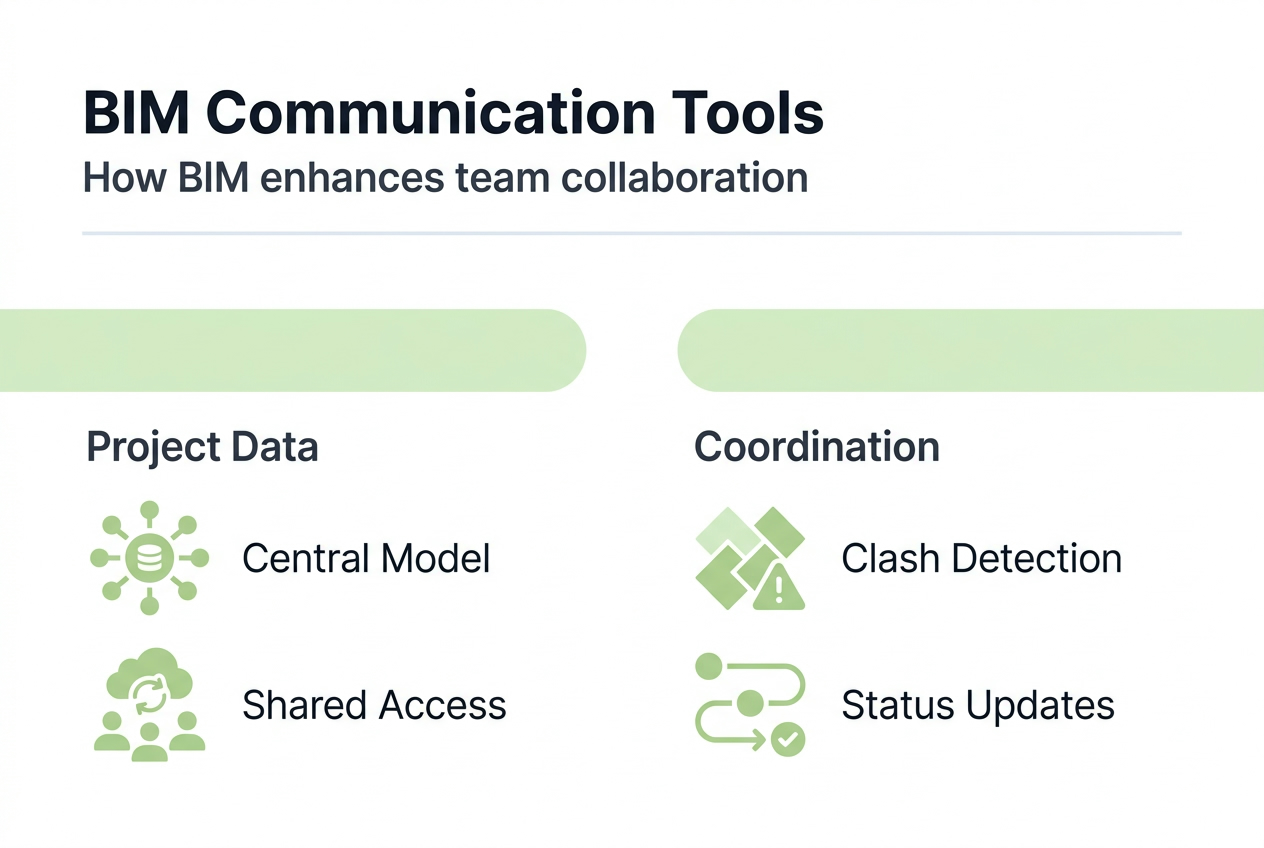
BIM acts as a single source of truth for all design data, architectural geometry, structural elements, and engineering specifications. Every stakeholder, from architects to structural engineers and contractors, accesses the same centralized model. This shared access ensures everyone works with consistent, up-to-date information rather than relying on outdated drawings or conflicting email threads.
Centralised models drastically reduce Requests for Information (RFIs), which are a common symptom of communication breakdowns. Studies show that BIM reduces RFIs by 30 to 40% and cuts project costs by 10 to 20% through improved coordination. When architects update a model section, structural engineers immediately see those changes, eliminating the lag time that traditionally causes errors.
Clear communication translates directly into cost and time savings. Projects using multidisciplinary BIM cut design changes substantially because teams identify conflicts early. Instead of discovering clashes during construction when changes are expensive, teams resolve issues in the design phase where adjustments cost a fraction of the price.
The benefits extend beyond error reduction. Centralised BIM models improve decision-making speed because stakeholders can visualise proposed changes in three dimensions. Structural engineers can immediately assess how an architectural modification affects load distribution. Contractors can evaluate constructability before fabrication begins.
Key benefits of centralised BIM communication:
- All disciplines access identical, current design data
- RFIs drop significantly, reducing administrative overhead
- Design conflicts surface early when they are cheapest to fix
- Decision-making accelerates through visual clarity
“BIM is not just a modelling tool. It is a communication platform that aligns everyone around a shared vision, reducing the friction that causes delays and budget overruns.”
Clash detection and preventing costly on-site conflicts
Clash detection represents one of BIM’s most powerful communication tools. BIM software automatically identifies conflicts between architectural and structural elements, such as a beam intersecting with ductwork or a structural column blocking a doorway. These clashes, if undetected until construction, cause expensive rework, schedule delays, and frustrated teams.

Resolving clashes before construction begins saves substantial money. Research indicates that clash detection reduces construction rework by up to 50%. For large projects, early clash resolution can save millions. One healthcare project saved £2.5 million by resolving just 10% of clashes identified through BIM coordination.
Projects using clash detection report a 15 to 20% reduction in construction delays. When teams address conflicts during design coordination meetings, they avoid the chaos of discovering problems on-site. Structural engineers and architects collaborate to redesign conflicting elements while changes remain straightforward and inexpensive.
Pro Tip: Schedule weekly clash detection reviews during the design phase. Assign clear ownership for resolving each clash type, such as architects handling spatial conflicts and engineers addressing structural issues. This rhythm keeps communication proactive rather than reactive.
The table below illustrates typical clash savings across project phases:
| Project Phase | Clash Resolution Cost | Time Impact |
|---|---|---|
| Design phase | Low (design adjustments only) | Minimal (hours to days) |
| Pre-construction | Medium (redesign and resubmittal) | Moderate (days to weeks) |
| During construction | High (rework, delays, materials) | Significant (weeks to months) |
| Post-construction | Very high (demolition, reconstruction) | Severe (months, legal issues) |
Early clash detection also improves communication quality. When teams review clash reports together, they develop shared understanding of spatial constraints and design priorities. Structural engineers gain insight into architectural intent. Architects better understand structural requirements. This mutual awareness prevents future conflicts and strengthens collaborative relationships.
Leveraging structural BIM clash detection benefits requires commitment to regular coordination cycles and clear protocols for issue resolution.
Interoperability challenges and the role of open BIM standards
Different disciplines often use diverse BIM software platforms. Architects may work in one application whilst structural engineers prefer another. This software diversity creates interoperability challenges that can disrupt communication if not properly managed.
Open BIM standards like Industry Foundation Classes (IFC) enable data to be shared between platforms without loss or corruption. IFC is a key standard facilitating interoperability between architectural and engineering software. When teams export and import models using IFC, geometric and semantic data transfers accurately, preserving design intent.
Prioritising open standards reduces communication breakdowns. Without standardised data exchange, teams resort to exporting simplified geometry or recreating elements manually. These workarounds introduce errors and waste time. When structural engineers receive a clean IFC model from architects, they can directly use that geometry for analysis and detailing.
Common Data Environments (CDEs) support real-time updates, keeping teams aligned. These platforms host the latest model versions and documentation, ensuring everyone accesses current information. CDEs combined with open standards create a communication infrastructure that scales across large, distributed teams.
Strategies for maintaining interoperability:
- Establish agreed IFC export and import protocols at project start
- Test data exchange workflows early to identify issues
- Use CDEs to manage model versions and prevent outdated file use
- Document software versions and settings to ensure consistency
Pro Tip: Create a project-specific BIM Execution Plan that defines exactly which IFC version, export settings, and naming conventions all parties will use. This clarity prevents countless hours troubleshooting data exchange problems.
Interoperability challenges are solvable when teams commit to open standards and clear workflows. Overcoming BIM adoption challenges requires not just technology but also process discipline and communication protocols.
Balancing detail and performance in BIM models for clear communication
Debate exists around the required level of detail in BIM models. Highly detailed models improve clarity by showing every bolt, connection, and material specification. However, excessive detail can slow software performance, making models cumbersome to navigate and coordinate.
Streamlined models improve performance and responsiveness, which keeps coordination meetings productive. Yet overly simplified models risk omitting important information that structural engineers or contractors need. Finding the right balance depends on project complexity, team capabilities, and specific communication needs.
Teams must align on appropriate detail levels for their project early in design. This alignment prevents misunderstandings where one discipline expects detailed connection information whilst another provides only schematic geometry. The debate on BIM detail levels continues, but practical teams establish clear expectations.
Understanding BIM level 2 protocols helps teams define suitable detail standards. Level of Development (LOD) specifications provide a common language for describing model detail progression from concept through construction.
The table below compares detail approaches:
| Approach | Communication Benefits | Performance Impact | Best For |
|---|---|---|---|
| High detail (LOD 400+) | Maximum clarity on connections, materials | Slower model performance, larger files | Complex structural systems, fabrication |
| Moderate detail (LOD 300) | Good balance of clarity and usability | Reasonable performance | Most building projects, coordination |
| Low detail (LOD 200) | Fast visualization, early concepts | Excellent performance | Schematic design, massing studies |
Clear communication requires appropriate detail, not maximum detail. A structural engineer coordinating beam locations needs accurate geometry and sizes, but may not need every bolt hole modelled. Contractors fabricating steel connections require high detail. Defining these needs upfront prevents wasted modelling effort and communication confusion.
Effective teams adjust detail progressively as design advances. Early phases use lower detail for quick iteration. Later phases add detail where needed for fabrication or analysis. This staged approach maintains both communication clarity and efficient workflows.
Discover BIM modelling services for seamless collaboration
Applying these BIM communication strategies requires both technical skill and process discipline. Professional BIM modelling services support clear design communication by delivering accurate, coordinated models that facilitate effective collaboration.
Expert structural BIM modelling helps detect clashes early and coordinate efficiently across disciplines. When your team needs coordinated models that improve communication and reduce project risks, all inclusive modelling services provide comprehensive support from concept through completion. Clear documentation through architectural and structural detail drafting further reduces delays and errors by ensuring construction teams understand design intent precisely.
Frequently asked questions
How does BIM improve communication between architects and structural engineers?
BIM provides a centralised, visual model that both architects and structural engineers access simultaneously. This shared platform eliminates version control issues and ensures everyone works with current information. Clash detection tools automatically identify conflicts, prompting productive conversations about design solutions before construction begins.
What are the biggest interoperability challenges in BIM workflows?
The main challenge is data loss or corruption when transferring models between different software platforms. Geometric simplification, missing semantic information, and incompatible file formats disrupt workflows. Open standards like IFC address these issues, but teams must establish clear export and import protocols to maintain data integrity throughout the project.
When should clash detection occur in a BIM project?
Clash detection should begin early in schematic design and continue regularly throughout design development and construction documentation. Weekly or bi-weekly clash detection reviews keep issues manageable and prevent conflict accumulation. Early detection costs far less to resolve than discovering clashes during construction.
How detailed should BIM models be for effective communication?
Model detail should match project phase and specific communication needs. Early design phases benefit from moderate detail (LOD 300) that shows relationships without slowing performance. Fabrication and construction phases require higher detail (LOD 400) for connections and assemblies. Align detail expectations across disciplines at project start to prevent misunderstandings.
Can small firms benefit from BIM for communication?
Absolutely. Even small teams benefit from centralized models and clash detection. Cloud-based BIM tools and services make the technology accessible without major infrastructure investment. The communication improvements and error reduction often justify BIM adoption regardless of firm size. Optimise drafting efficiency in BIM projects to maximise value.
What is a Common Data Environment and why does it matter?
A Common Data Environment (CDE) is a centralized digital platform where all project information, models, and documentation are stored and shared. CDEs ensure teams always access the latest versions, preventing outdated information from causing errors. They support real-time collaboration and maintain clear audit trails for accountability.