

Building Information Modeling has transformed architecture and construction, yet many firms struggle to implement it effectively. Despite 74% of architecture firms using BIM, persistent barriers around cost, skills, and interoperability continue to hinder smooth adoption. This guide explores what BIM really is, current adoption rates in the US, common obstacles, emerging trends, and practical strategies to help you succeed with BIM in 2026.
Table of Contents
- Introduction To BIM And Its Importance In US Construction
- Current State Of BIM Adoption In The US
- Key Challenges Hindering BIM Adoption
- Common Misconceptions About BIM Adoption
- Emerging Trends And Technological Advances In BIM
- Practical Strategies To Overcome BIM Adoption Barriers
- Conclusion And Forward-Looking Insights
- Transform Your Projects With Expert BIM Support
- Frequently Asked Questions About BIM Adoption Challenges
Key takeaways
| Point | Details |
|---|---|
| High adoption but persistent gaps | Large architecture firms reach 92% BIM adoption, but smaller firms face cost and skill barriers that slow implementation. |
| Interoperability remains a major challenge | Fragmented standards and inconsistent open BIM implementation create data exchange friction across projects. |
| Emerging technologies accelerate BIM value | AI automation, digital twins, and cloud platforms are transforming BIM workflows and boosting productivity by 25%. |
| Practical strategies enable success | Adopting open standards, investing in training, leveraging incentives, and outsourcing modelling can overcome adoption barriers. |
Introduction to BIM and its importance in US construction
Building Information Modeling represents far more than digital drawings. BIM is an integrated digital process that encompasses 3D models enriched with data on cost, scheduling, materials, and operations throughout a building’s lifecycle. This collaborative approach transforms how architects, engineers, contractors, and owners share information and make decisions.
The benefits of BIM extend across every phase of construction projects:
- Enhanced collaboration through centralised, real-time data access for all project stakeholders
- Reduced costs by identifying design conflicts early, before expensive rework becomes necessary
- Streamlined workflows that improve scheduling accuracy and material procurement efficiency
- Better facility management with comprehensive as-built data carried forward into operations
The construction industry increasingly recognises these advantages. Growth in BIM adoption reflects widespread acknowledgment that traditional 2D methods cannot match the coordination and efficiency BIM delivers on complex projects.
Modern construction demands tighter budgets, faster timelines, and higher quality outcomes. BIM addresses all three simultaneously by providing a single source of truth that prevents miscommunication and costly errors. For architects and project managers facing pressure to deliver more with less, BIM has become essential rather than optional.
Pro tip: Start your BIM journey by identifying one pain point in your current workflow, such as coordination issues between disciplines, then implement BIM specifically to solve that problem before expanding to other areas.
Current state of BIM adoption in the US
BIM adoption in the United States has reached impressive levels, particularly among established architecture firms. Research shows that 74% of architecture firms use BIM, with large firms reaching 92% adoption. This widespread implementation demonstrates BIM’s proven value in delivering project outcomes.
Adoption rates vary significantly by firm size and project type:
| Firm size | BIM adoption rate | Primary drivers |
|---|---|---|
| Large firms (50+ employees) | 92% | Complex projects, client mandates, competitive advantage |
| Medium firms (10-49 employees) | 78% | Growing client expectations, efficiency gains |
| Small firms (under 10 employees) | 58% | Selected projects, cost considerations |
Several US states now mandate BIM for public infrastructure projects, creating regulatory pressure that accelerates adoption. Wisconsin, Georgia, and Texas have implemented BIM requirements for state-funded buildings, whilst major cities like New York and Los Angeles encourage or require BIM on large public works.
Government incentives and industry initiatives further support BIM implementation. Federal agencies including the General Services Administration recommend BIM for projects exceeding certain budget thresholds. Professional organisations provide resources and training to help firms transition successfully.
The adoption landscape continues evolving as smaller practices recognise BIM’s benefits. Many discover that solutions like all inclusive modelling and structural BIM modelling from concept to completion make implementation more accessible than initially assumed.
Key challenges hindering BIM adoption
Despite high adoption rates, significant obstacles prevent many firms from realising BIM’s full potential. Understanding these barriers helps you develop strategies to overcome them.

The absence of a unified federal BIM mandate creates fragmented standards across states and municipalities. Whilst some jurisdictions require specific BIM deliverables, others have no requirements at all. This patchwork regulatory environment forces firms working across multiple states to navigate inconsistent expectations and compliance requirements.
Interoperability issues due to incomplete implementation of open BIM standards remain a significant barrier to smooth BIM adoption in the US. Different software platforms handle data exchange differently, creating friction when models move between disciplines or project phases. The Industry Foundation Classes (IFC) format promises universal compatibility, but inconsistent implementation across applications undermines this goal.
Cost and training challenges particularly impact smaller architecture firms:
- Software licences, hardware upgrades, and ongoing subscriptions represent substantial upfront investment
- Staff training requires time away from billable work, creating short-term productivity losses
- Smaller project budgets may not justify BIM implementation costs without clear ROI demonstration
- Finding experienced BIM talent becomes difficult in competitive labour markets
Organisational resistance compounds these technical and financial obstacles. Team members comfortable with traditional methods may resist workflow changes. Leadership may hesitate to disrupt established processes without guaranteed returns. These cultural barriers often prove more difficult to overcome than technical ones.
Many firms underestimate the change management required for successful BIM adoption. Technical capability matters less than organisational willingness to embrace new collaborative workflows.
Understanding BIM Level 2 requirements and establishing efficient structural drawings workflows with BIM integration helps address these implementation challenges systematically.
Common misconceptions about BIM adoption
Several persistent myths discourage firms from pursuing BIM implementation. Clearing these misconceptions removes psychological barriers to adoption.
Many architects mistakenly believe BIM means only 3D visualisation. In reality, BIM encompasses multidimensional data including cost estimates (5D), scheduling (4D), facility management information (6D), and sustainability metrics (7D). The visual model serves as a framework for organising comprehensive project data, not the end goal itself.
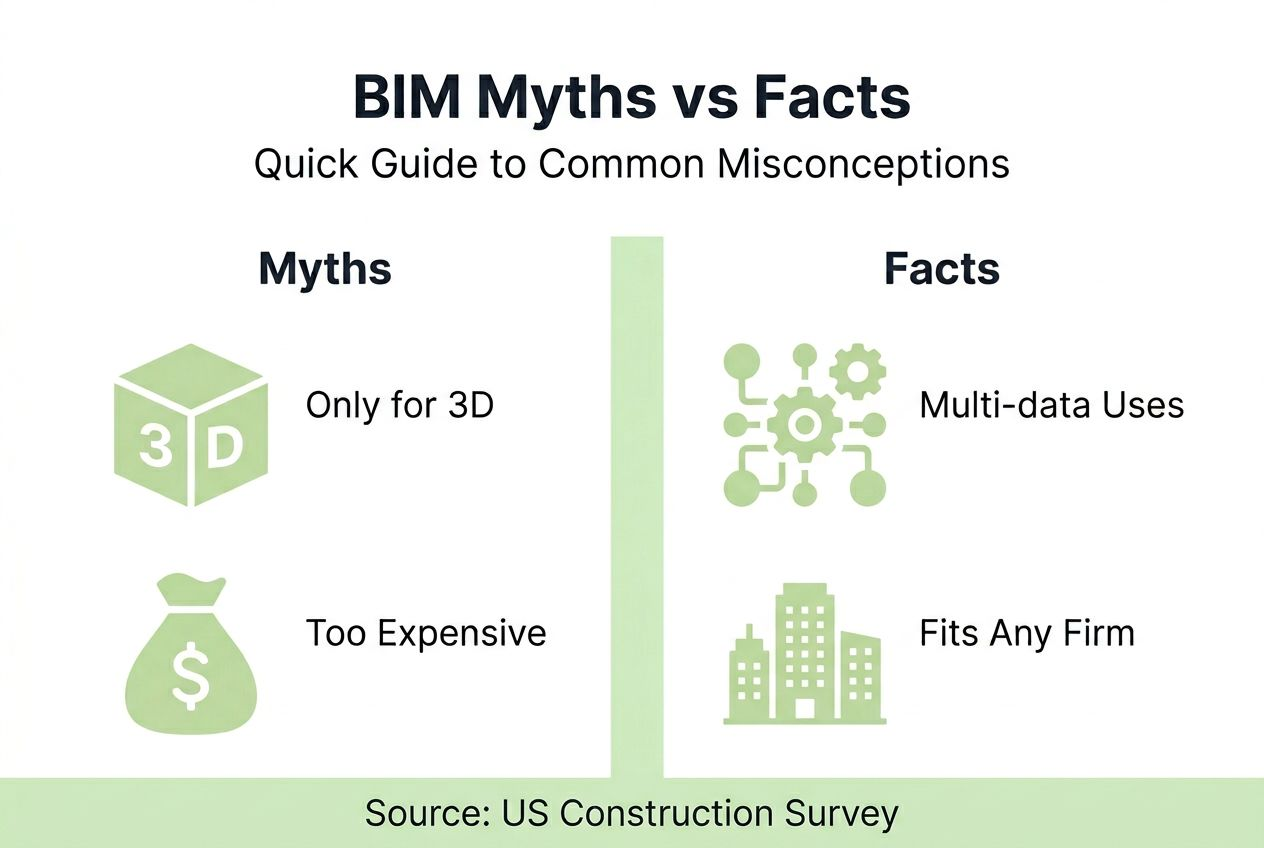
Another common misconception suggests BIM suits only large firms with substantial resources. Whilst enterprise-scale implementation requires significant investment, smaller practices successfully adopt BIM by starting small and scaling gradually. Cloud-based platforms and subscription pricing models have dramatically reduced entry barriers compared to legacy software licensing.
Some professionals assume nationwide mandates must drive adoption for BIM to succeed. However, efficiency benefits and competitive advantages motivate most firms to implement BIM voluntarily. Clients increasingly expect BIM deliverables regardless of regulatory requirements. Firms that wait for mandates risk falling behind competitors already capturing BIM’s productivity gains.
Pro tip: Begin with pilot projects that clearly demonstrate ROI before committing to firm-wide implementation. Success on one project builds internal support and provides valuable lessons for broader rollout.
The reality is that multidisciplinary BIM cuts design changes by 50% on many projects, delivering measurable value regardless of firm size. Exploring BIM.Supply services shows how outsourcing options make BIM accessible even for practices with limited internal resources.
Emerging trends and technological advances in BIM
Rapid technological innovation continues expanding BIM’s capabilities and accelerating adoption across the US construction industry. Understanding these trends helps you position your practice for future success.
Artificial intelligence integration represents the most transformative development in BIM technology. AI automates repetitive tasks like clash detection, code compliance checking, and quantity take-offs, improving productivity by approximately 25%. Machine learning algorithms identify patterns across projects, suggesting optimal design solutions based on historical performance data.
Digital twin technology extends BIM beyond construction into building operations. Digital twins create real-time virtual replicas of physical structures, feeding operational data back into the BIM model continuously. This enables predictive maintenance, energy optimisation, and space utilisation analysis throughout a building’s lifecycle.
Cloud-based BIM platforms fundamentally change how teams collaborate:
- Real-time model access from any location eliminates version control problems
- Reduced hardware requirements lower implementation costs for smaller firms
- Automated backups and disaster recovery protect critical project data
- Seamless integration with other cloud tools streamlines workflows
| Technology | Impact on BIM adoption | Implementation timeline |
|---|---|---|
| AI automation | 25% productivity gain, reduced manual errors | Currently available |
| Digital twins | Lifecycle value realisation, operations integration | Early adoption phase |
| Cloud platforms | Enhanced collaboration, lower costs | Mainstream adoption |
| Mobile BIM | Field-to-office connectivity, real-time updates | Rapidly expanding |
These advances make BIM more powerful and accessible simultaneously. Following BIM modelling trends in 2026 helps you stay current with industry developments. Events like BIM World Paris 2026 showcase emerging innovations worth monitoring.
Practical strategies to overcome BIM adoption barriers
Successful BIM implementation requires deliberate planning and strategic resource allocation. These actionable steps help you navigate common obstacles and accelerate adoption.
-
Adopt openBIM standards from the start to minimise interoperability problems. Prioritise software platforms with robust IFC support and test data exchange workflows early in projects. Establish clear protocols for model handoffs between disciplines and project phases.
-
Invest in targeted training that addresses your team’s specific skill gaps. Online courses, vendor workshops, and industry certifications build capability efficiently. Budget 10-15% of software costs for training in the first year. Create internal mentorship programmes pairing experienced BIM users with those learning.
-
Leverage available government incentives and industry programmes supporting BIM adoption. Research state and local initiatives offering grants, tax credits, or technical assistance. Join industry associations providing member resources and networking opportunities with experienced practitioners.
-
Start with pilot projects that demonstrate clear value before committing to firm-wide implementation. Choose projects with collaborative clients, reasonable complexity, and sufficient budget to support proper BIM execution. Document lessons learned and ROI metrics to build internal support.
-
Consider outsourcing BIM modelling to control costs and accelerate deployment. External specialists provide immediate capability whilst your team develops skills gradually. This hybrid approach reduces risk and maintains project momentum during the transition period.
Pro tip: Establish clear BIM execution plans (BEPs) for every project, defining roles, responsibilities, deliverables, and quality standards before work begins. This prevents misunderstandings and ensures all stakeholders share common expectations.
Practical resources like services to review structural drawings and cut errors by 40% and professional as-built drawings services demonstrate how targeted outsourcing fills capability gaps whilst building internal competency.
Conclusion and forward-looking insights
BIM adoption has reached a critical inflection point in US architecture and construction. Whilst challenges around standardisation, interoperability, and costs persist, the benefits of enhanced collaboration and improved project efficiency make BIM essential for competitive practice in 2026.
Overcoming remaining barriers requires coordinated efforts across multiple fronts. Industry organisations must continue developing robust open standards. Government agencies should provide clearer guidance and consistent requirements. Individual firms need strategic implementation plans that address technical, financial, and organisational challenges simultaneously.
Emerging technologies like artificial intelligence, digital twins, and cloud platforms will further enhance BIM’s value proposition. Early adopters of these innovations will capture competitive advantages whilst late movers risk falling behind industry standards. The question is no longer whether to adopt BIM, but how to implement it most effectively for your specific practice context.
Transform your projects with expert BIM support
Navigating BIM adoption challenges becomes significantly easier with the right partner supporting your transition. You understand the theory now you need practical implementation that delivers results without disrupting your current operations.
BIM.Supply specialises in helping architecture and engineering firms implement BIM successfully through flexible, unit-rate pricing that scales with your needs. Our comprehensive modelling and drafting services eliminate the need for substantial upfront investment in software and training whilst you build internal capability. Whether you need support on a single pilot project or ongoing assistance across your entire portfolio, we provide the expertise to ensure smooth implementation and measurable results. Our team handles the technical complexity whilst you focus on design excellence and client relationships, making BIM adoption practical and profitable from day one.
Frequently asked questions about BIM adoption challenges
What is the biggest challenge in BIM adoption?
Interoperability issues create the most persistent problems for firms implementing BIM. Inconsistent implementation of open standards like IFC across different software platforms causes data loss and requires manual rework when models transfer between disciplines. Establishing clear protocols and testing exchange workflows early helps mitigate these problems.
Can small firms afford BIM implementation?
Yes, small architecture firms successfully implement BIM by starting strategically and scaling gradually. Cloud-based subscription pricing, targeted training investment, and selective outsourcing make BIM accessible without enterprise-level budgets. Focus initial efforts on projects with clear ROI potential, then expand as capability and confidence grow.
How does AI change BIM workflows?
Artificial intelligence automates time-consuming tasks like clash detection, code compliance checking, and quantity calculations, improving productivity by approximately 25%. AI analyses patterns across projects to suggest optimal design solutions and identify potential issues before they become problems. This shifts team focus from repetitive work to higher-value design decisions.
Are there US federal BIM mandates?
No comprehensive federal BIM mandate exists, though several agencies recommend or require BIM for specific project types. Individual states and municipalities implement their own requirements, creating a fragmented regulatory landscape. Many firms adopt BIM voluntarily to capture efficiency benefits and meet growing client expectations rather than regulatory compliance.
What quick wins improve BIM adoption success?
Start with pilot projects that clearly demonstrate value to build internal support. Establish standardised templates and libraries to reduce repetitive modelling work. Create clear BIM execution plans defining roles and deliverables before projects begin. Invest in targeted training for key team members who can mentor others. Consider outsourcing complex modelling tasks whilst developing internal capability.