

Many BIM professionals assume that implementing Building Information Modelling will eliminate all project clashes and errors. However, research shows that whilst BIM reduces rework by 70 to 85 per cent in time and 65 per cent in cost, it cannot prevent every issue. Understanding what BIM model validation truly entails and how it benefits construction projects is essential for architects, structural engineers, and project managers responsible for implementing and validating BIM models. This guide clarifies validation processes, explores automated techniques, and provides actionable best practices.
Table of Contents
- Understanding BIM Model Validation And Its Importance
- Core Techniques And Tools For BIM Model Validation
- Navigating BIM Clash Detection Challenges And Tolerance Management
- Future Trends And Best Practices In Automated BIM Model Validation
- Discover Expert BIM Modelling And Validation Services
Key takeaways
| Point | Details |
|---|---|
| Validation reduces clashes significantly | BIM validation cuts rework time by 70 to 85 per cent but requires careful tolerance management to optimise results. |
| Automated tools outperform manual checks | AI and machine learning driven validation methods deliver higher efficiency and accuracy than traditional manual approaches. |
| Clash detection remains foundational | Whilst clash detection is core, continuous validation throughout project phases prevents costly downstream issues. |
| Early rule based checking saves costs | Implementing automated rule based validation early in design prevents expensive rework during construction. |
Understanding BIM model validation and its importance
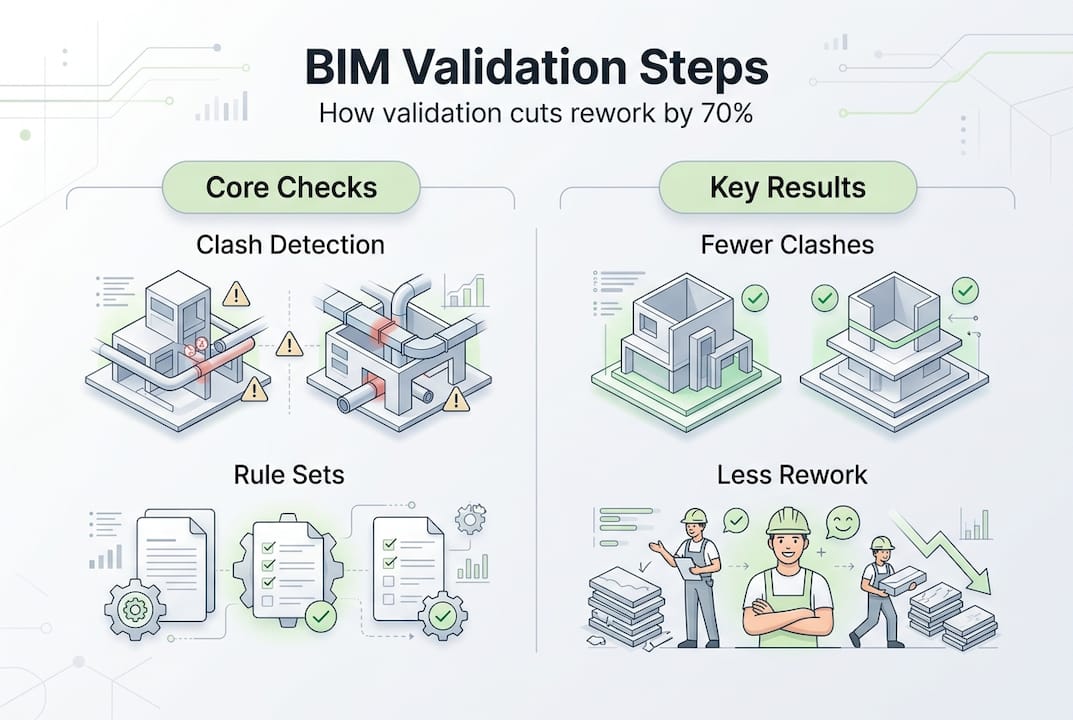
BIM model validation is a quality control process that verifies design data consistency across disciplines and project phases. The core goal is to minimise costly errors and clashes before construction begins. Proper validation directly impacts project cost, timeline, and communication between stakeholders. Empirical analysis demonstrates that BIM reduces rework by 70 to 85 per cent in time and 65 per cent in cost for bridge projects, proving the financial value of thorough validation.
Validation encompasses several key elements that work together to ensure model quality. Clash detection identifies spatial conflicts between building elements across disciplines. Rule based checking verifies that models comply with design standards, building codes, and project specifications. Tolerance management adjusts sensitivity thresholds to balance detection accuracy with practical construction realities. Each element plays a distinct role in preventing issues that would otherwise surface during construction when fixes are exponentially more expensive.
The engineering BIM process integrates validation at multiple stages rather than treating it as a final check. Early validation during schematic design catches fundamental coordination issues when changes are simple and inexpensive. Continuous validation during design development ensures that evolving models maintain quality as complexity increases. Final validation before construction documentation confirms that all disciplines align and meet project requirements.
Without systematic validation, projects face significant risks. Undetected clashes lead to on site conflicts requiring expensive rework and schedule delays. Inconsistent data across disciplines creates communication breakdowns and coordination failures. Non compliant designs may fail regulatory reviews or require costly redesign. These risks multiply in complex projects with multiple disciplines and tight schedules, making validation essential rather than optional.
Validation also enhances collaboration by providing objective quality metrics that all stakeholders understand. When teams share validation results, they can prioritise issues based on severity and impact. This transparency builds trust and enables faster decision making. Validation transforms BIM from a modelling tool into a coordination platform that aligns project teams around shared quality standards.
Core techniques and tools for BIM model validation
Clash detection forms the foundation of BIM validation, using software like Navisworks to identify spatial conflicts between building elements. Model complexity directly influences clash risk through the Relative Quality Coefficient, which quantifies how design intricacy correlates with potential coordination issues. Understanding this relationship helps teams allocate validation resources effectively, focusing intensive checking on high complexity zones whilst streamlining reviews of simpler areas.
Automated validation represents a significant evolution beyond manual checking. Research comparing approaches found that automated model checking using natural language processing and machine learning outperforms manual validation in both efficiency and accuracy. Automated systems can process thousands of rules simultaneously, checking compliance with building codes, design standards, and project specifications in minutes rather than days. This speed enables iterative validation throughout design rather than limiting checks to milestone reviews.
Several validation techniques complement clash detection to provide comprehensive quality control:
- Rule based checking verifies that model elements meet specified requirements for properties, relationships, and constraints
- Geometric validation ensures that elements have correct dimensions, orientations, and spatial relationships
- Data integrity checks confirm that required properties are present, complete, and formatted correctly
- Consistency validation identifies discrepancies between linked models or different project views
The performance gap between manual and automated validation is substantial. Manual checking relies on human reviewers examining models visually or running limited automated reports. This approach is time intensive, inconsistent across reviewers, and prone to missing issues in complex models. Automated validation executes comprehensive rule sets consistently, documents all findings systematically, and scales effortlessly as model complexity increases.
Managing clash tolerance thresholds critically affects validation outcomes. Setting tolerances too tight generates excessive false positives that overwhelm teams with insignificant issues. Setting tolerances too loose misses genuine problems that will surface during construction. Effective tolerance management requires understanding typical construction clearances, coordination practices, and project specific requirements.

Pro Tip: Implement rule based validation during early design phases rather than waiting for clash detection at design development. Early prevention identifies fundamental coordination issues when changes are simple, avoiding the exponential cost increase of fixing problems discovered during construction documentation or on site.
Current BIM modelling trends for 2026 show increasing adoption of automated validation as teams recognise efficiency gains. Integration with common data environments enables continuous validation as models evolve, replacing periodic manual reviews. This shift aligns with broader industry movement towards data driven project delivery and real time quality monitoring.
The table below compares validation approaches across key performance dimensions:
| Validation Approach | Processing Speed | Consistency | Scalability | Error Detection Rate |
|---|---|---|---|---|
| Manual Visual Review | Slow | Variable | Limited | 60 to 70 per cent |
| Semi Automated Reports | Moderate | Good | Moderate | 75 to 85 per cent |
| Fully Automated AI ML | Fast | Excellent | High | 90 to 95 per cent |
Understanding essential BIM deliverables helps teams define validation requirements aligned with project needs. Different deliverables require different validation intensity, with construction models needing more rigorous checking than early conceptual models. Tailoring validation scope to deliverable requirements optimises resource allocation whilst maintaining appropriate quality standards.
Navigating BIM clash detection challenges and tolerance management
Detailed analysis of actual project clashes reveals patterns that inform practical validation strategies. Research examining MEP structural coordination found that 92 per cent of 404 clashes ranged between 30 and 299 millimetres, with the most frequent category falling between 100 and 199 millimetres. This data demonstrates that whilst BIM significantly reduces clashes, it cannot eliminate all coordination issues. Understanding typical clash dimensions helps teams set realistic tolerance thresholds and prioritise resolution efforts.
The distribution of clash sizes provides insight into validation effectiveness:
| Clash Size Range | Percentage of Total | Typical Cause | Resolution Difficulty |
|---|---|---|---|
| 30 to 99 mm | 28 per cent | Minor coordination gaps | Low |
| 100 to 199 mm | 35 per cent | Standard clearance conflicts | Moderate |
| 200 to 299 mm | 29 per cent | Significant spatial conflicts | High |
| 300 mm plus | 8 per cent | Major design coordination failures | Very High |
Tolerance management directly impacts validation outcomes by controlling detection sensitivity. Construction reality includes acceptable tolerances for installation, thermal expansion, and practical clearances. Setting validation tolerances that mirror construction tolerances produces actionable results rather than theoretical perfection. A 25 millimetre tolerance might be appropriate for structural steel connections, whilst a 50 millimetre tolerance suits ductwork routing in congested ceiling spaces.
Common pitfalls in tolerance management create unnecessary friction in validation workflows:
- Using uniform tolerances across all building systems ignores varying installation requirements and coordination practices
- Failing to adjust tolerances as design progresses from schematic through construction documentation
- Ignoring discipline specific standards that define acceptable clearances and coordination practices
- Setting tolerances based on software defaults rather than project specific construction methods
Pro Tip: Monitor clash patterns throughout design phases and adjust tolerance thresholds dynamically based on observed results. If a tolerance setting generates excessive false positives in a specific building system, increase the threshold for that category whilst maintaining tighter control elsewhere. This adaptive approach optimises validation efficiency without compromising quality.
The reality that BIM reduces but does not eliminate clashes stems from several factors. Design complexity in modern buildings often exceeds the precision achievable through digital coordination alone. Construction tolerances and field conditions introduce variability that models cannot fully predict. Coordination between disciplines involves trade offs where perfect clash elimination is neither achievable nor necessary. Effective validation focuses on identifying and resolving significant issues whilst accepting minor conflicts that field coordination can address.
Understanding BIM adoption challenges helps teams anticipate validation obstacles and develop mitigation strategies. Organisations new to BIM often struggle with tolerance management because they lack experience interpreting results in construction context. Building this expertise requires comparing validation findings with actual field conditions over multiple projects, developing institutional knowledge about which clashes matter and which are acceptable.
Tolerance settings also affect validation timing and frequency. Tighter tolerances require more processing time and generate more results to review. Looser tolerances enable faster validation cycles but risk missing important issues. Balancing these factors requires understanding project schedule constraints, team capacity for reviewing results, and the relative cost of false positives versus false negatives in the specific project context.
Future trends and best practices in automated BIM model validation
The construction industry is shifting towards continuous automated validation at scale using artificial intelligence driven methods. Automated validation technologies enable teams to detect and resolve clashes earlier in design when changes are least expensive. This evolution from periodic manual checking to continuous automated monitoring represents a fundamental transformation in how projects maintain model quality throughout delivery.
Early rule based prevention delivers substantially better outcomes than reactive clash resolution. When validation rules execute automatically as designers work, issues surface immediately rather than accumulating until formal coordination reviews. This immediate feedback enables designers to correct problems before they propagate through dependent elements, avoiding the cascading rework that characterises late stage clash resolution. Scale automation means validation can run continuously without human intervention, processing models as they evolve.
Despite promising capabilities, current automated validation technologies face maturity gaps that limit adoption. Model data preparation remains labour intensive, requiring standardisation and cleanup before automated systems can process information reliably. Rule interpretation challenges arise when building codes and standards use ambiguous language that automated systems struggle to parse accurately. These gaps mean that whilst automated validation outperforms manual checking, it still requires human oversight and intervention.
Five best practices enable successful integration of automated validation into project workflows:
- Establish clear validation requirements during project setup, defining which rules apply and what tolerance thresholds are appropriate for each building system and project phase.
- Implement continuous validation that executes automatically as models develop, providing immediate feedback rather than waiting for formal coordination milestones.
- Standardise model data structures and naming conventions across disciplines to ensure automated systems can reliably identify and check elements.
- Train project teams on interpreting automated validation results, distinguishing genuine issues from false positives and understanding resolution priorities.
- Document validation findings and resolutions systematically, building institutional knowledge that improves rule definitions and tolerance settings for future projects.
AI driven validation will become the standard approach for large complex projects, enabling coordination at a scale and speed impossible through manual methods. The competitive advantage will shift from whether teams use automated validation to how effectively they integrate it into design workflows and leverage insights to improve project outcomes.
Continuous validation reduces rework and communication friction by maintaining model quality throughout design rather than discovering issues during late stage coordination reviews. When teams receive immediate feedback on coordination problems, they can resolve conflicts through design adjustments rather than expensive rework. This proactive approach aligns with broader industry trends towards preventing problems rather than reacting to them.
Multidisciplinary BIM coordination benefits significantly from automated validation by providing objective quality metrics that all disciplines understand. When architectural, structural, and MEP teams share validation results, they can prioritise coordination efforts based on severity and impact rather than subjective judgement. This transparency accelerates decision making and builds trust across project teams.
Understanding why BIM improves communication in building design helps teams leverage validation results for collaboration. Validation findings provide concrete evidence of coordination issues, replacing ambiguous verbal descriptions with precise geometric data. This clarity enables faster resolution because teams can visualise problems and evaluate solutions using shared digital models rather than interpreting conflicting two dimensional drawings.
The evolution towards automated validation reflects broader construction industry digitalisation. As projects become more complex and schedules compress, manual validation methods cannot scale to meet coordination demands. Automated systems provide the speed, consistency, and comprehensiveness required for modern project delivery whilst reducing the labour intensity that makes manual validation prohibitively expensive on large projects.
Discover expert BIM modelling and validation services
Effective BIM model validation requires not just understanding techniques but also having access to expert modelling services that implement quality control throughout project delivery. BIM.Supply provides comprehensive all inclusive modelling services from initial concept through construction completion, ensuring that validation is integrated at every project phase rather than treated as a final check.
Our structural BIM modelling expertise ensures that models meet the rigorous quality standards required for effective validation and coordination. We implement rule based checking and continuous validation throughout design development, catching issues early when resolution is straightforward. For projects requiring flexible support during iterative design phases, our professional drafting services provide hourly assistance that adapts to evolving project needs whilst maintaining consistent quality standards.
Frequently asked questions
What is the primary purpose of BIM model validation?
BIM model validation ensures design coordination across disciplines by identifying clashes, verifying compliance with standards, and maintaining data quality throughout project delivery. The primary purpose is reducing costly rework and construction delays by catching coordination issues during design when changes are least expensive. Validation transforms BIM models from visualisation tools into reliable coordination platforms that align project teams around shared quality standards.
How does automated validation differ from manual clash detection?
Automated validation executes comprehensive rule sets continuously as models develop, checking thousands of requirements simultaneously with consistent accuracy. Manual clash detection relies on human reviewers running periodic checks, which is time intensive and prone to missing issues in complex models. Automated systems outperform manual methods in speed, consistency, and scalability whilst enabling continuous quality monitoring rather than milestone based reviews.
Why does BIM reduce but not eliminate all project clashes?
BIM significantly reduces clashes through digital coordination but cannot eliminate all issues because construction involves physical tolerances, field conditions, and practical trade offs between disciplines. Research shows 92 per cent of clashes fall between 30 and 299 millimetres, representing coordination gaps that are substantially smaller than pre BIM conflicts but still require resolution. Effective validation focuses on identifying significant issues whilst accepting minor conflicts that field coordination can address within normal construction tolerances.
When should validation be integrated into project workflows?
Validation should begin during early schematic design rather than waiting for design development or construction documentation. Early rule based checking identifies fundamental coordination issues when changes are simple and inexpensive, preventing problems from propagating through dependent elements. Continuous validation throughout design phases maintains quality as complexity increases, whilst final validation before construction confirms that all disciplines align and meet project requirements.
What tolerance settings are appropriate for clash detection?
Appropriate tolerance settings vary by building system, construction method, and project phase, typically ranging from 25 to 50 millimetres for most applications. Structural connections often require tighter 25 millimetre tolerances, whilst MEP routing in congested spaces may use 50 millimetre thresholds. Settings should mirror actual construction tolerances rather than pursuing theoretical perfection, and teams should adjust thresholds dynamically based on observed clash patterns to balance detection accuracy with practical resolution needs.